
2025 was a very busy election year in Florida. In addition to a myriad of local contests, the state was home to 9 special elections for Congressional or State Legislative seats. There has not been such a large number of specials in Florida for several decades; with many years featuring none or only a handful. In total we saw two Congressional races, three State Senate races, and four State House races.
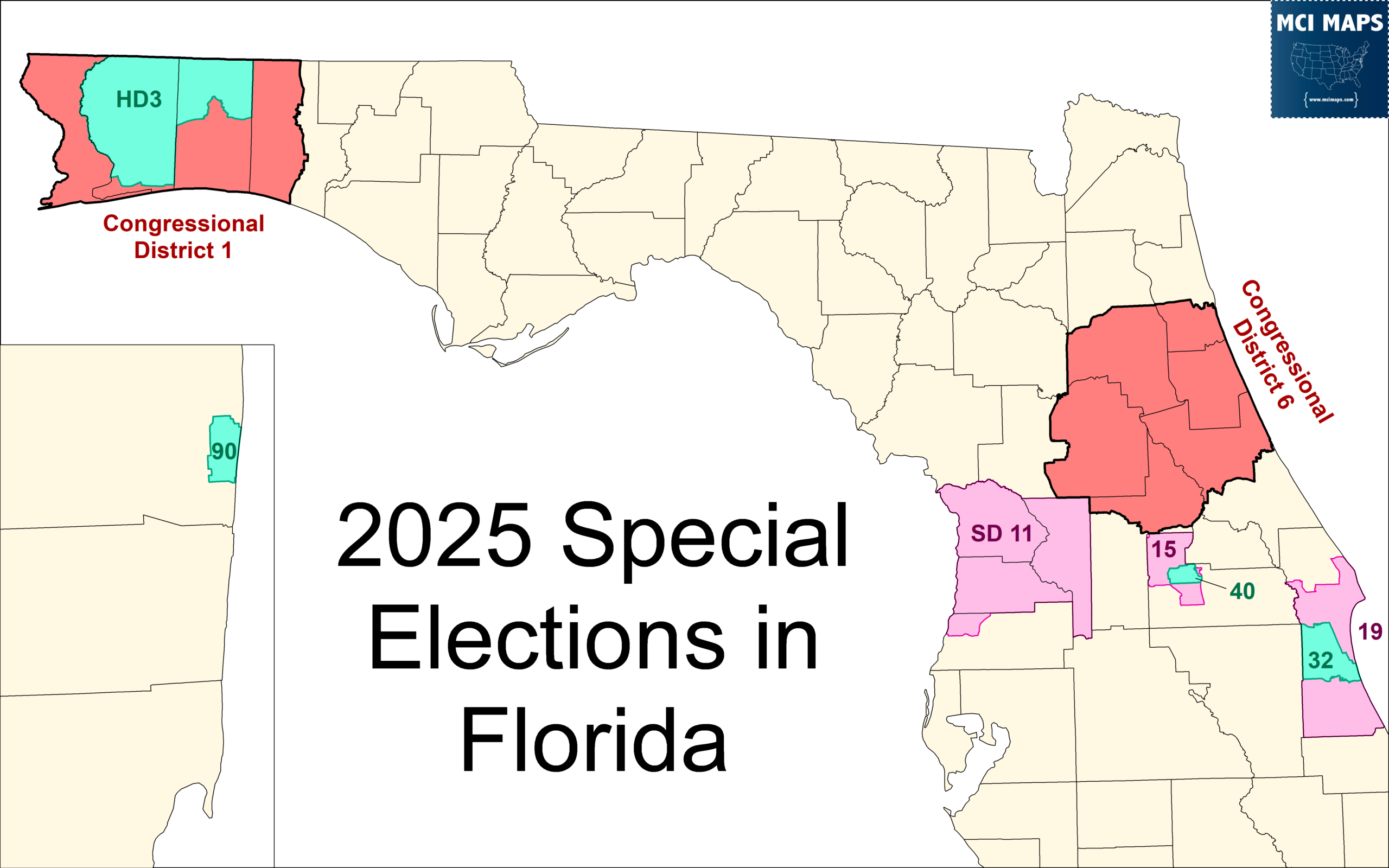
This large batch of elections, each with varying degrees of contention, calls for some retrospective analysis. I covered these races to varying degrees through different newsletters or largely just on my twitter page. Here I want to provide a central hub for maps and data breakdowns for all these respective races.
However, before getting into each race, lets look at the clear Democratic trend line we saw in these respective races.
Swings to the Democrats
The story of elections in 2025 has largely been a story of Democratic gains. With Trump’s administration becoming unpopular quickly into his term, Democrats have seen major swings in special elections across the country. This continued throughout the year, culminating with big wins in state elections in Virginia, Pennsylvania, and New Jersey. In Florida, Democrats saw similar left-wing swings across the legislative specials. It also culminated with Democrats flipping the Miami Mayoral Election in December – a race I wrote about here.
All of Florida’s special election occurred in either deep red or deep blue districts. As a result, no seats switched parties. However, the trend-lines were very clear. Below is the Presidential margin for each district compared with how the special election margin turned out.
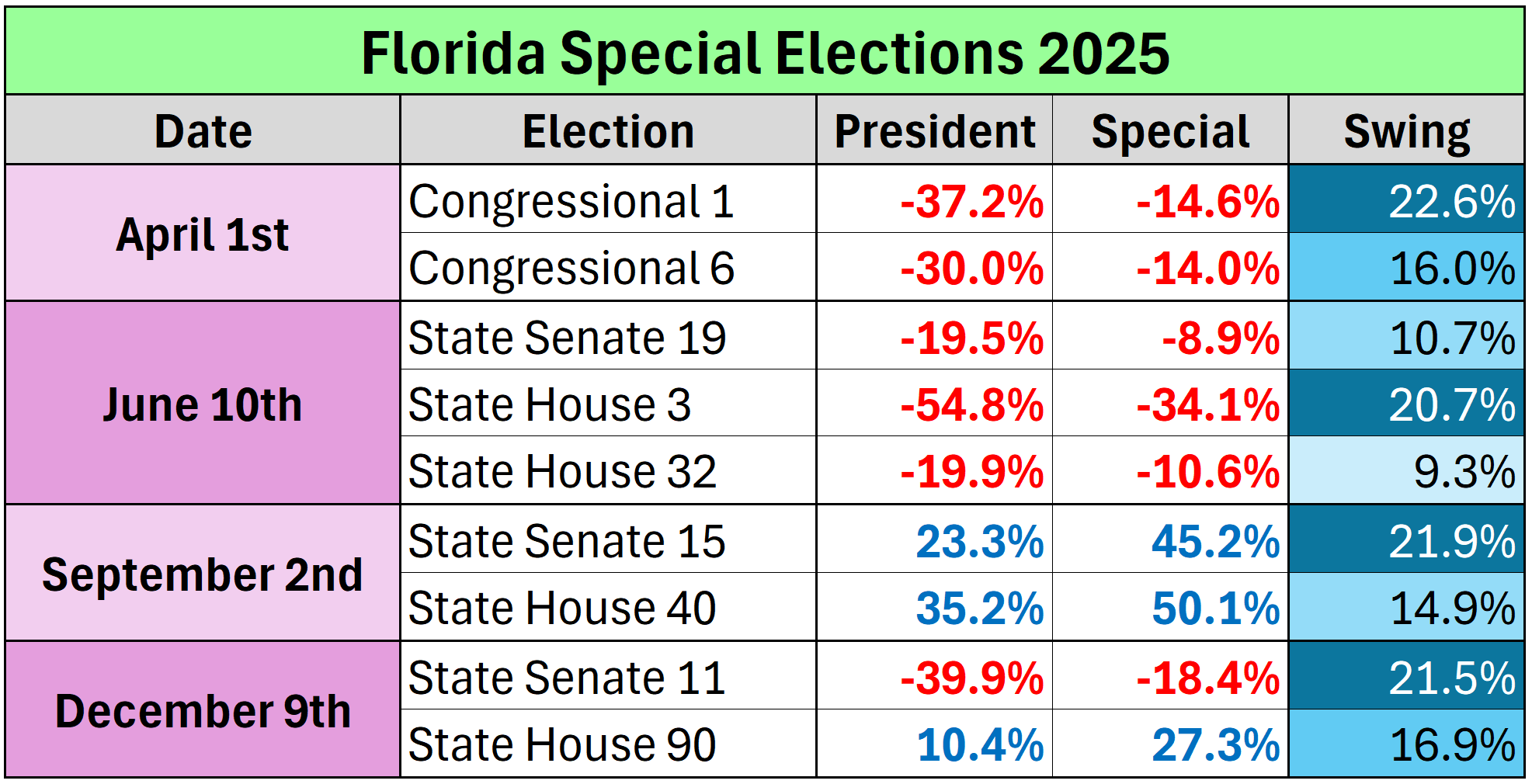
Florida drew national attention with its April Congressional specials. Both of these saw massive swings to the left. This trend did not change after the national cameras turned away. None of the legislative specials that followed saw a great deal of focus or money outside of some contested primaries. However, they all showed similar Democratic swings. The average Democratic shift to the left across all districts was 17%.
Each district saw its swing occur for an array of reasons. Turnout drove the swing in some, while big wins with independents was a major driver in others. Broadly, however, Democrats had good news to report on both turnout and efforts to win over swing voters.
Turnout in the Specials
On the turnout front, every district got better for democrats. Turnout was of course a fraction of what it was compared to 2024. Turnout peaked with the Congressional specials and fell off a cliff after that. At the height was 35% turnout for Congressional district 6. At the lower end, turnout was just 9% for the FL House 3 race. However, regardless of total ballots cast, the main story is the turnout dynamics between Republicans and Democrats.
Back in the 2024 elections, Republicans had better turnout than their Democratic counterparts in every one of these special election districts. In the 2025 specials, EVERY district saw Democrats get a higher portion of their voters to the polls. The “D v R” column for each year is the Democratic turnout % minus the Republican turnout %.
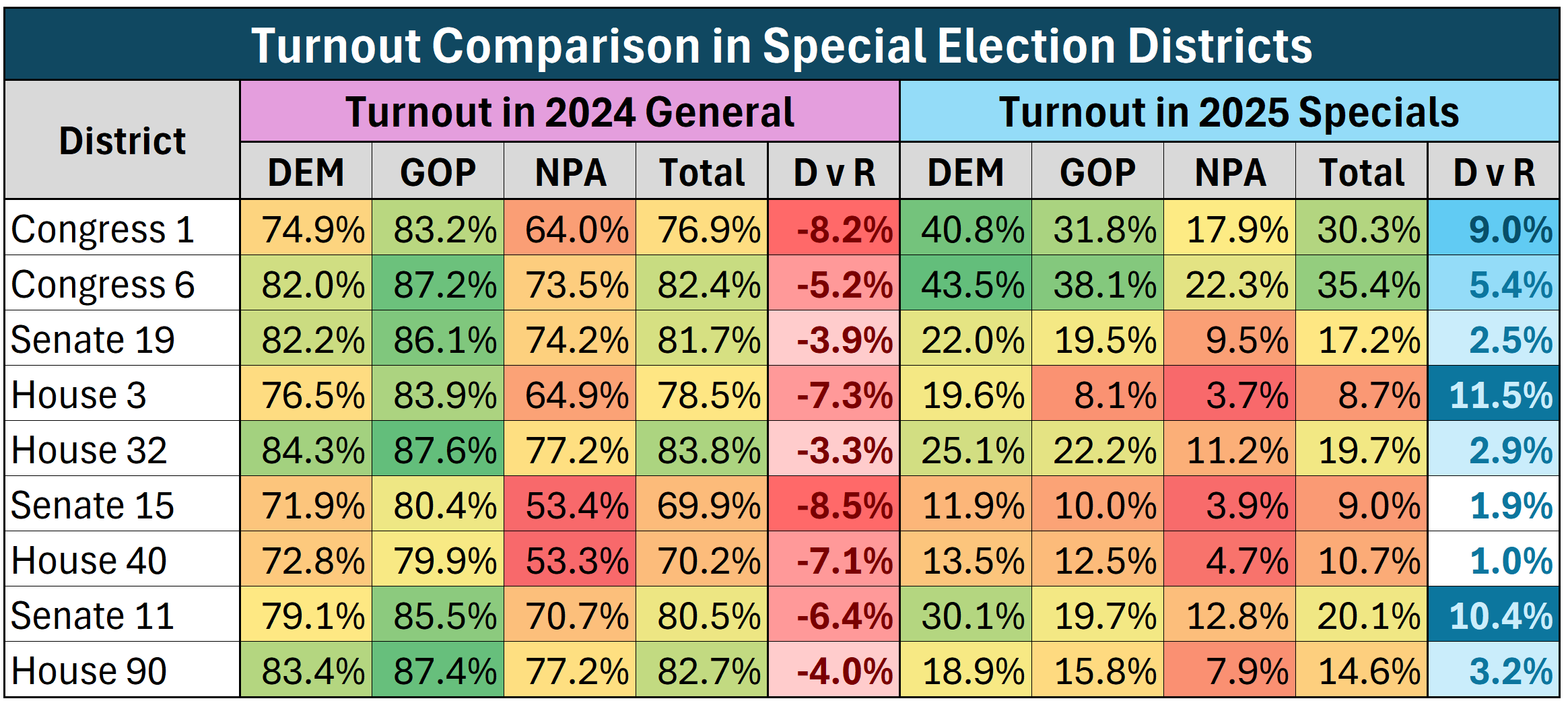
The Democratic lead in turnout for every special was a notable shift from 2024. Even in strong Democratic years, like 2018, or back in the Obama era in 2012, Republicans often get a higher % of their voters out than Democrats. These results, however, show that enthusiasm sits more firmly on the Democratic side. Yes this turnout is low, but the fact is Democrats showed up more than Republicans did in every contest.
Party Loyalty and Independent Voters
The other big issue was swings with independent voters and likely Democrats retaining a larger share of their voters.
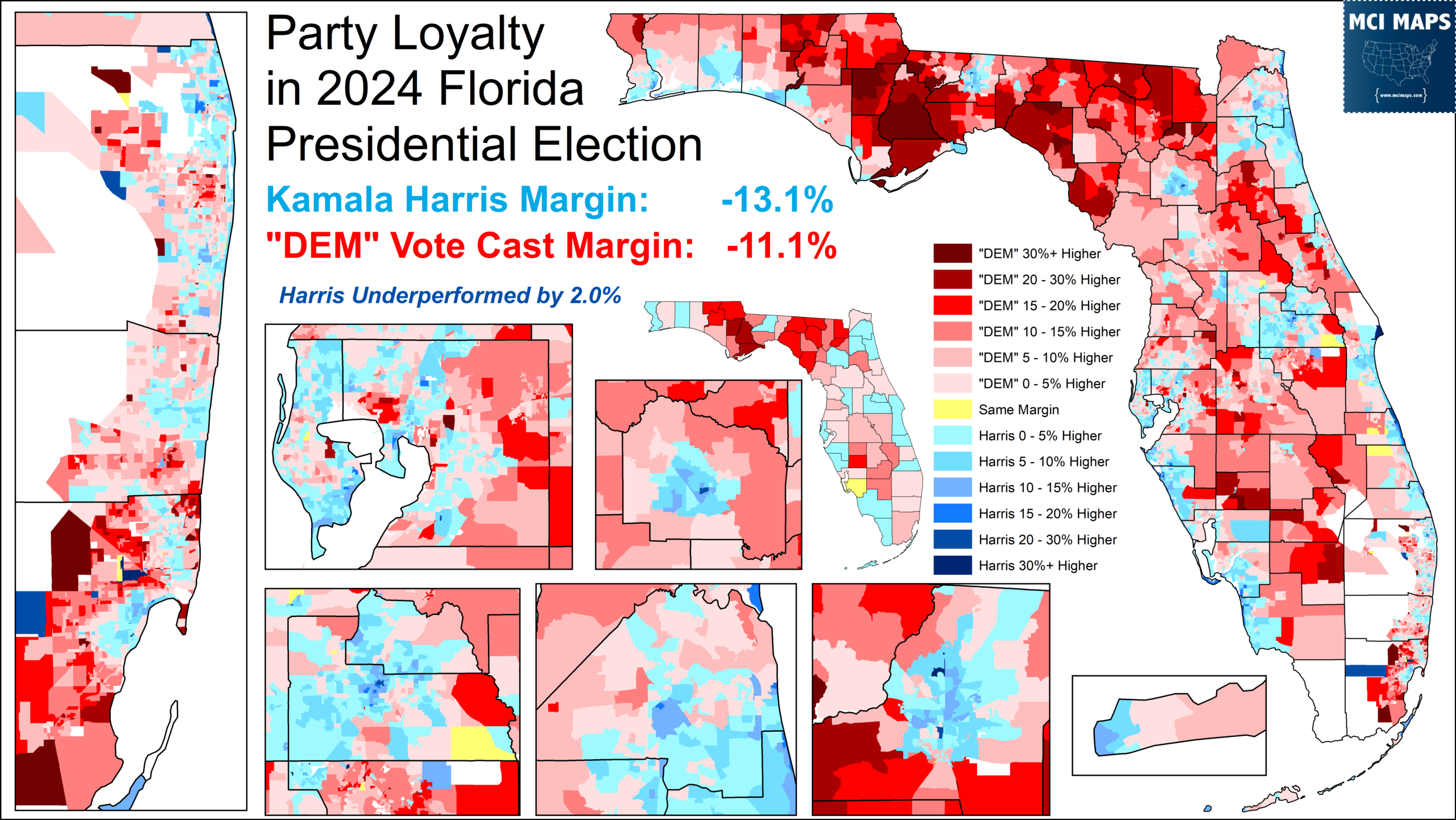
I’ve talked about this in previous articles, but one way you can examine elections in Florida is to compare the margin candidates get with the share of the vote that the two parties make up. For example, in 2024, Republicans made up 42.7% of the vote cast to Democrats 31.6%.
- This meant the electorate was GOP +11%. Kamala Harris, meanwhile, lost the state by 13%.
- Hence she under-performed the party metrics by 2%.
You can see that performance below, with blue being precincts/counties Harris did better than the party vote cast margin, and red being areas where she did worse.
Two factors can cause a candidate to over/under perform their party margin.
- 1) The no-party (independent) voters swing heavily to one party
- 2) Voters registered to a party are crossing over and voting the other side.
The precinct results show Harris radically under-performing in the rural white panhandle and in many heavily Hispanic areas. The panhandle results reflect the presence of conservative white Democrats that often vote GOP for top-ticket races. Meanwhile, the under-performance in Hispanic areas reflects the gains Republicans made there; winning batches of Hispanic Democrats and winning Hispanic NPAs. On the other side, we see Harris outperform in assorted suburbs across the state; reflecting her either doing much better with the independents in these areas and/or winning over some never-Trump Republicans.
Now with that explained, lets look at party loyalty in these nine special election districts. How the Presidential margin compared with vote-cast margin can be seen below. That “party loyalty” column is the over/under performance I discussed.
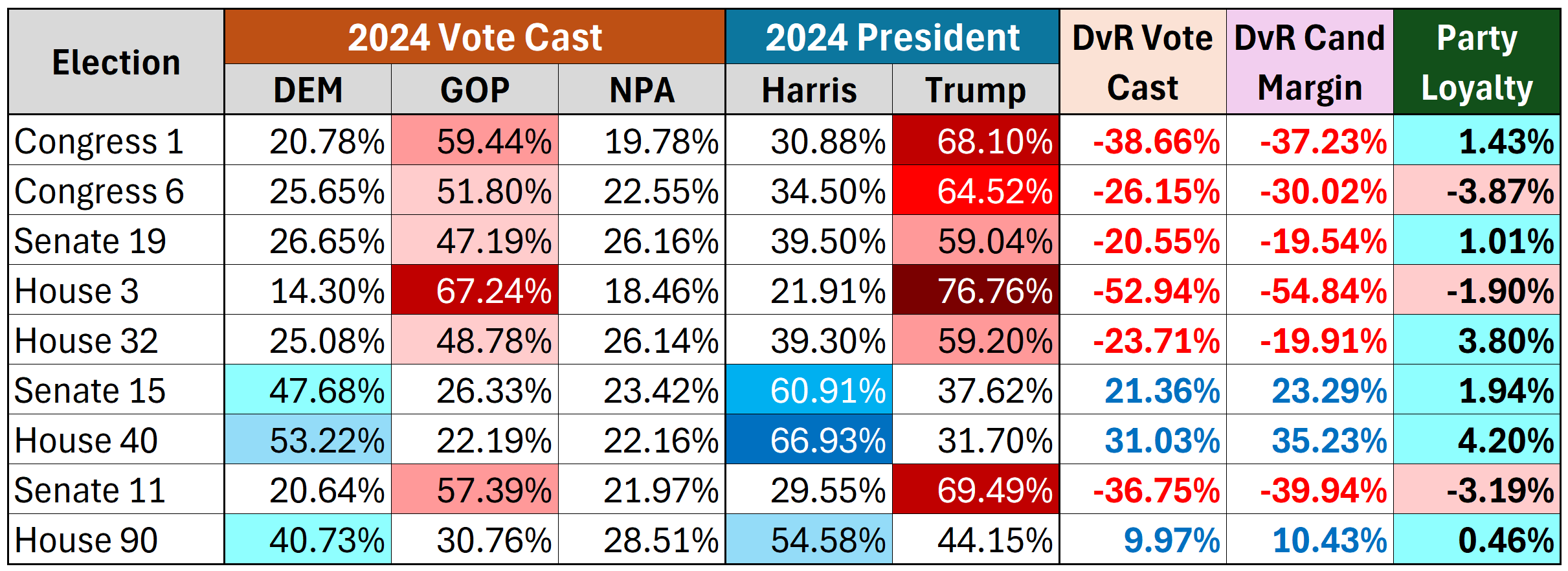
Every district has a party loyalty gap that was within 5%, often much closer. Harris narrowly managed to out-perform in most districts, but by very small margins. In 2024, the party makeup of the electorate was a strong predictor of candidate margins in these districts.
Now lets look at the 2025 Party Loyalty breakdowns for the special elections. This time we see a MASSIVE democratic over-performance across all districts. Seats saw a Democratic over-performance ranging from 7% to 15%.
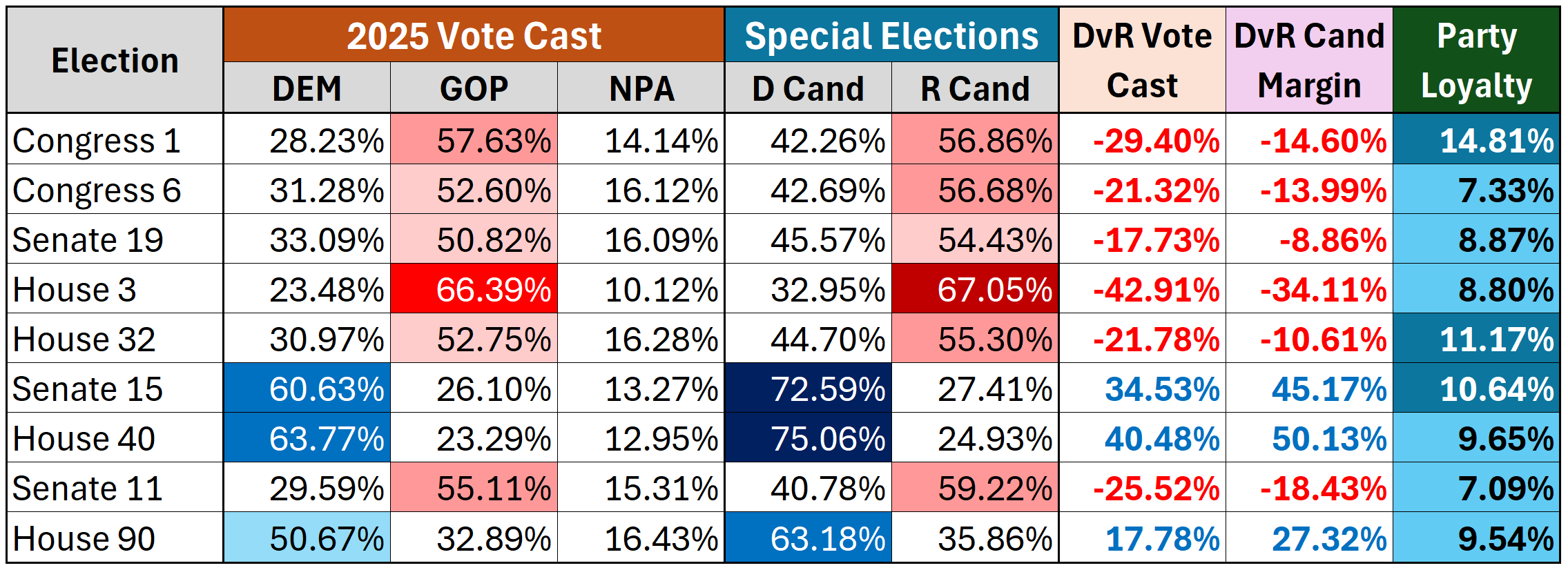
The biggest over-performance started the year off, with Democrat Gay Valimont far outperforming party metrics in the Congressional 1 special. Even in races where the Democratic candidate barely raised money or had an active campaign, they greatly outperformed.
The aggregate results for the districts show voters are taking their frustration out on the GOP. Now lets look into each race to see what they had in common, and what varied by contest.
The Congressional Specials
The special elections for the 1st and 6th Congressional districts wound up generating a great deal of attention and money despite both seats being so heavily Republican. I wrote about the campaigns for both districts in a March article, so I would go there for more information on the details. That article has more details on the candidate profiles and party involvement; stuff I will only touch on in broad strokes here.
Congressional District 1
The 1st Congressional District was opened up by the resignation of Congressman Matt Gaetz. In the weeks following Trump’s election, it was announced that Gaetz was set to be his Attorney General. Upon the announcement Gaetz resigned Congress early, not even waiting for confirmation that would take place in January. This was because Gaetz wanted to stop the release of an ethics investigation that would show he had sex with a 17 year old. The information came out, however, and it quickly became clear Gaetz could never secure the votes to become AG. However, he stuck to his resignation, leaving the seat open. This was a heavily Republican seat, voting for Trump by 37 points in the last election.
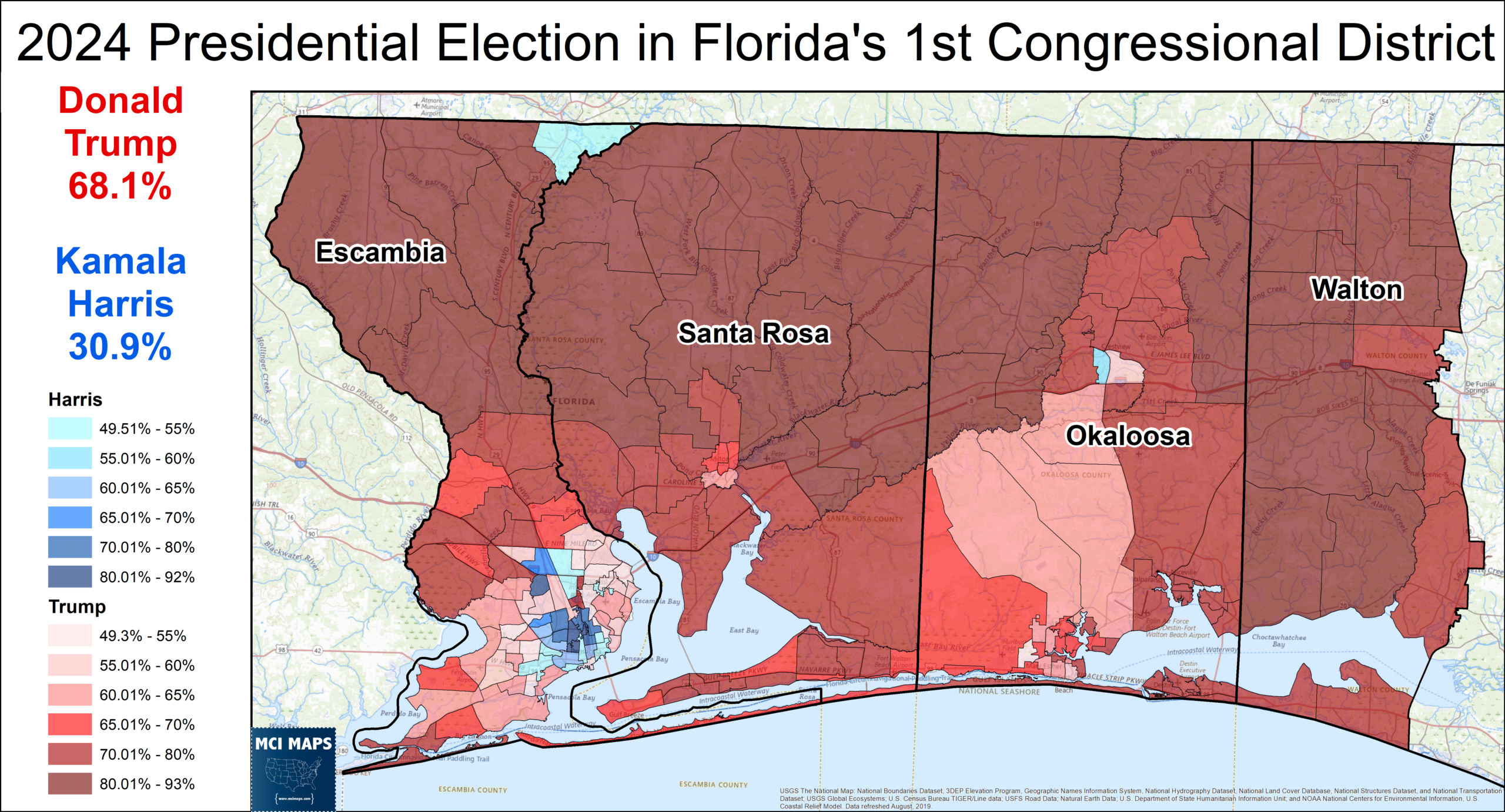
The front-runner for the race was Jimmy Patronis, who at the time served as Florida Chief Financial Officer. Patronis quickly had the endorsement of Donald Trump, a move that scared-off several other Republican contenders. Only one serious challenger to Patronis emerged in the Republican Primary; State Representative Joel Rudman.
Representing parts of Santa Rosa and Okaloosa Counties, Rudman attacked Patronis for the fact he did not live in the district. Patronis resided in Bay County, representing the area back in the state house, but having no overlap with the 1st Congressional. Living in a Congressional district is not a requirement, but it can sour voters to you. Patronis struggled to address the issue; lying about redistricting being the reason he didn’t live in the seat. The issue ultimately did not mater much, as Rudman could not keep pace with Patronis’ fundraising and name ID. Patronis dominated the primary with 66% of the vote and Rudman at just 10% – with a large batch of other candidates rounding out the rest.
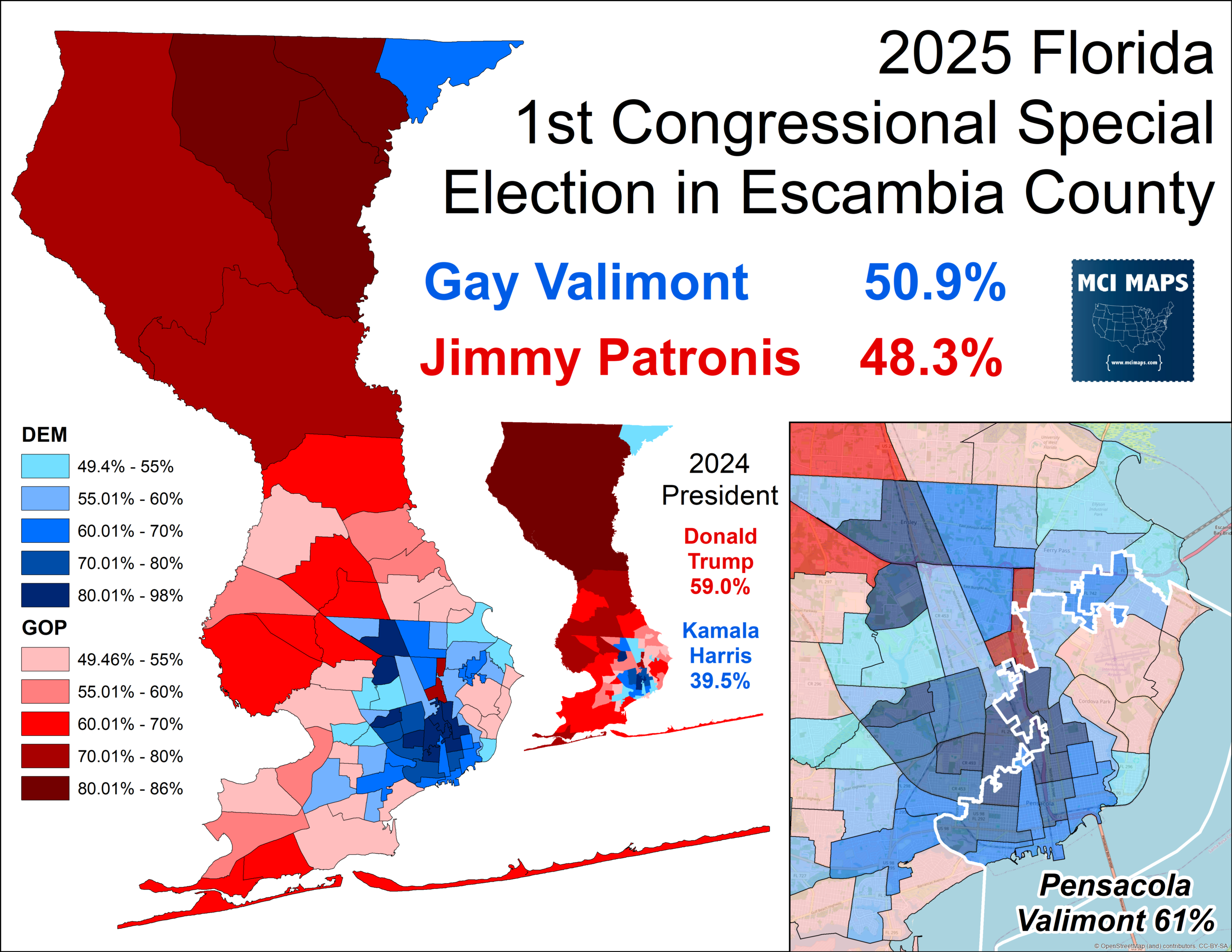
Patronis then, however, had to face off with Democrat Gay Valimont. Seizing on anti-Trump sentiment among Democratic voters, Valimont was able to raise over $6,000,000 in donations from across the country. She also ran a very aggressive campaign focused on veterans affairs issues and property insurance costs; two very potent issues in this part of Florida. Republicans even conceded she ran a far stronger campaign than Patronis, but everyone understood flipping such a district was next to impossible. Valimont secured a strong showing however, losing to Patronis by just 14%.
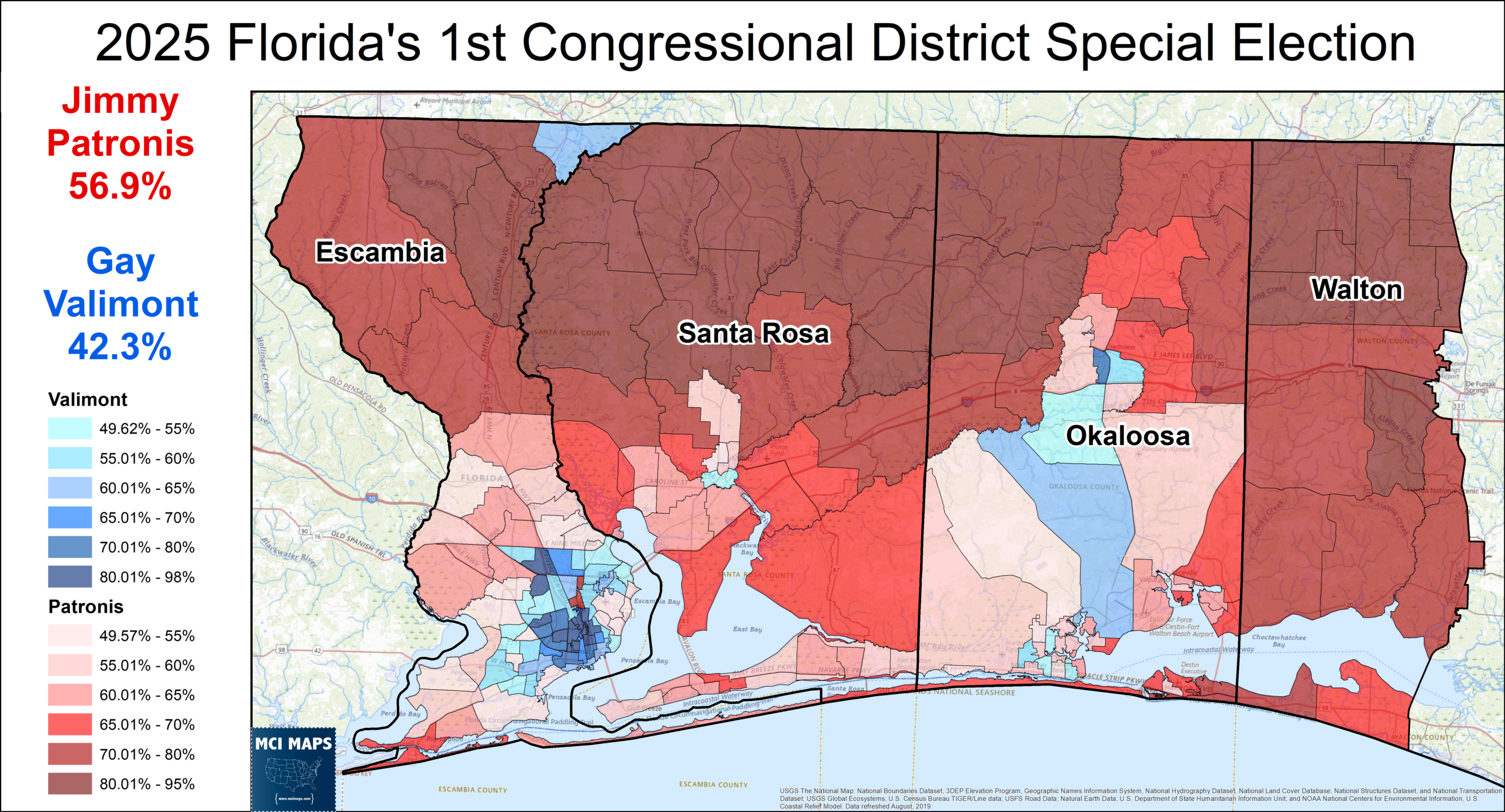
The result saw Valimont become the first Democrat running for federal office to win Escambia County in nearly two decades.
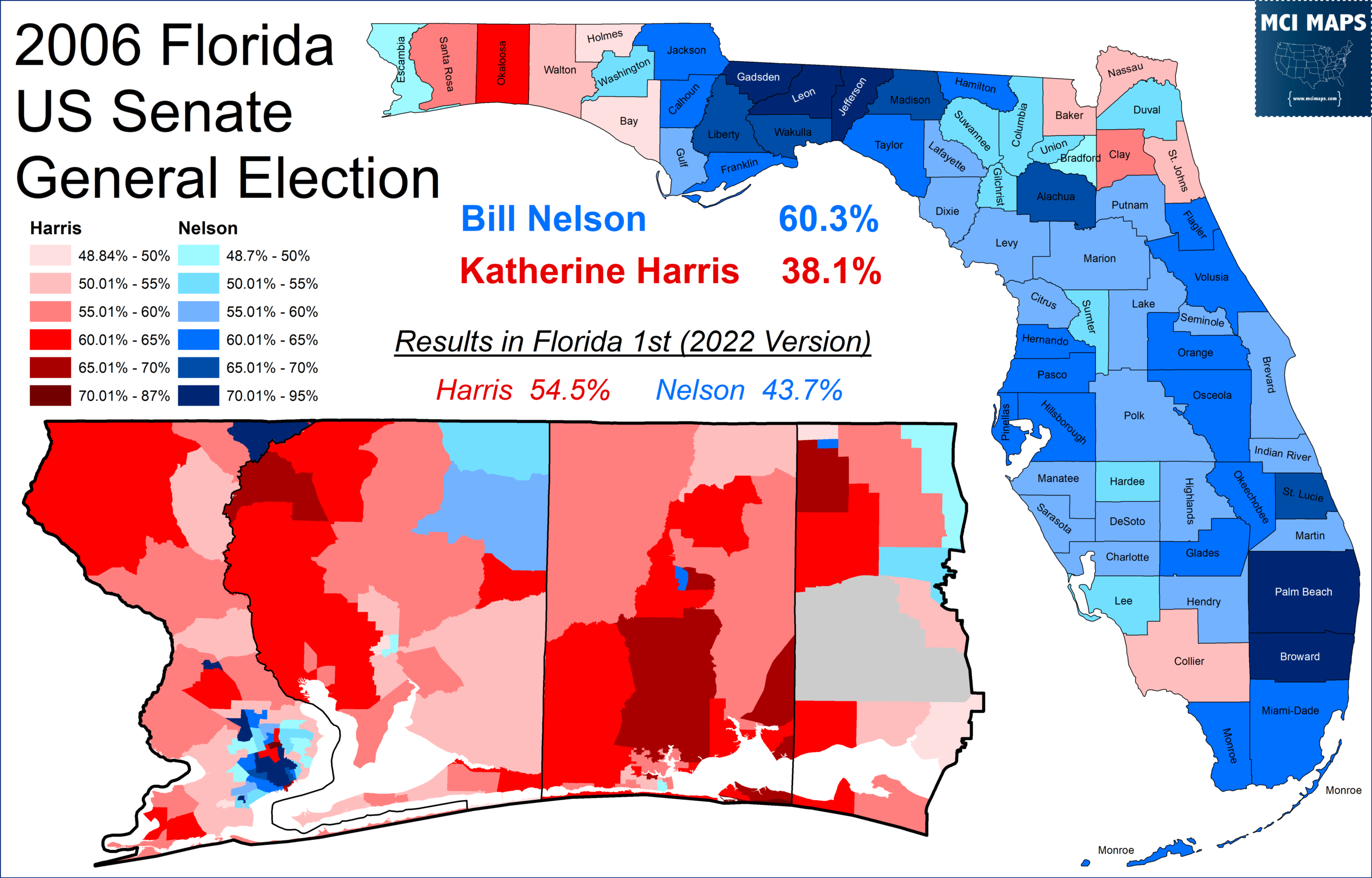
Valimont’s showing, while still a double digit loss, was still a historic result for the area. The last federal Democrat to win Escambia was Bill Nelson in his 2006 landslide re-election. That year, while Nelson won Florida by 22 points, he still lost the 1st Congressional by 11%; just a bit better than Valimont.
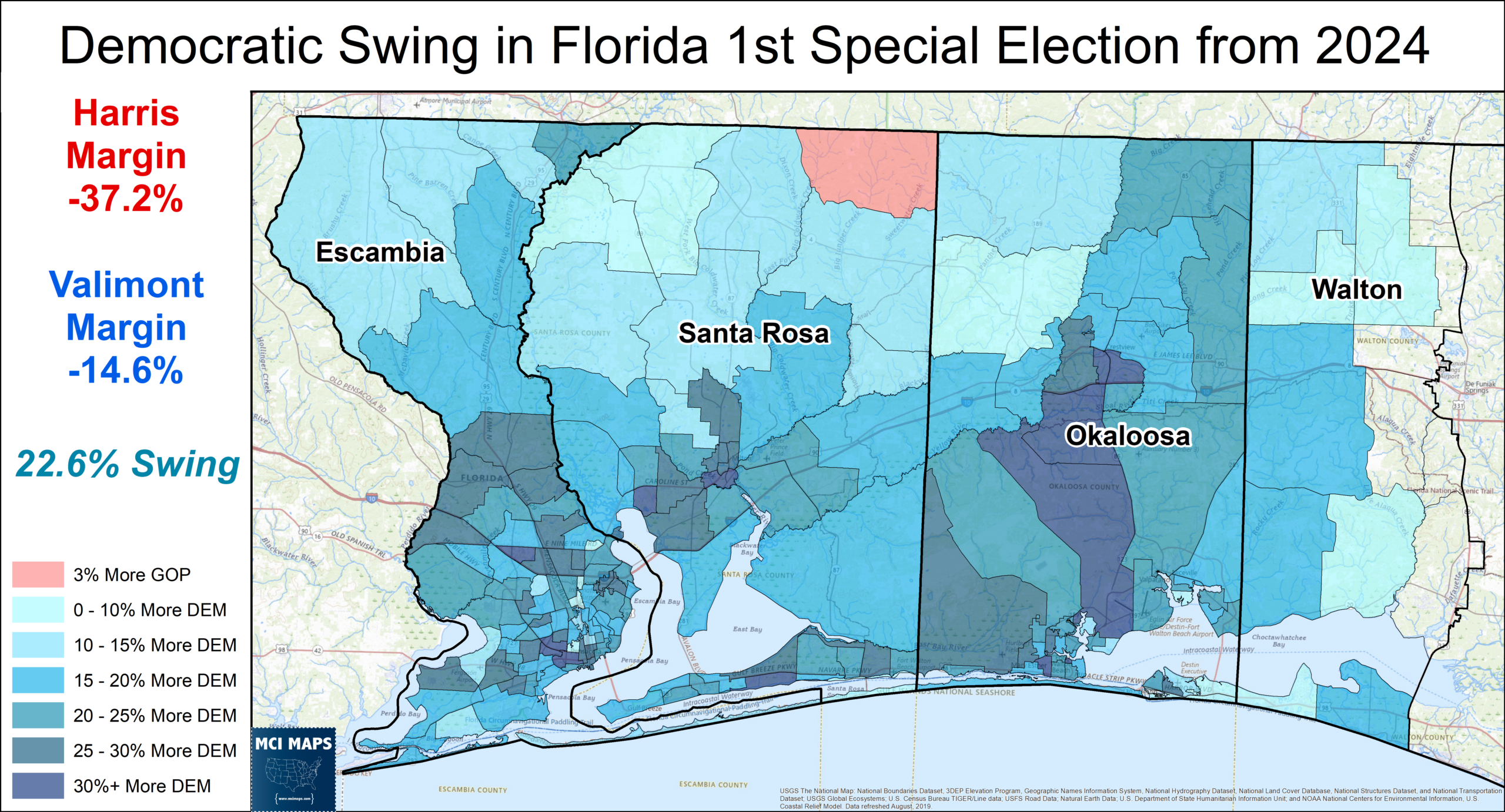
Comparing the results to 2024, Valimont outperformed Harris across every precinct save for one. In the coastal communities and military-heavy districts, the over-performances was over 20%.
Now part of this swing can be tied to turnout. After all, registered Democrats had 9% stronger turnout than Republicans in the district. However, even with that dynamic, Republicans made up a vast majority of the vote cast. To hit on the “party loyalty” topic I touched on before, here is how the candidate margins compared with the margin of votes cast. While Republicans had a 29% lead in vote cast, Patronis only won by 14.6%. Valimont outperformed party metrics across all counties.
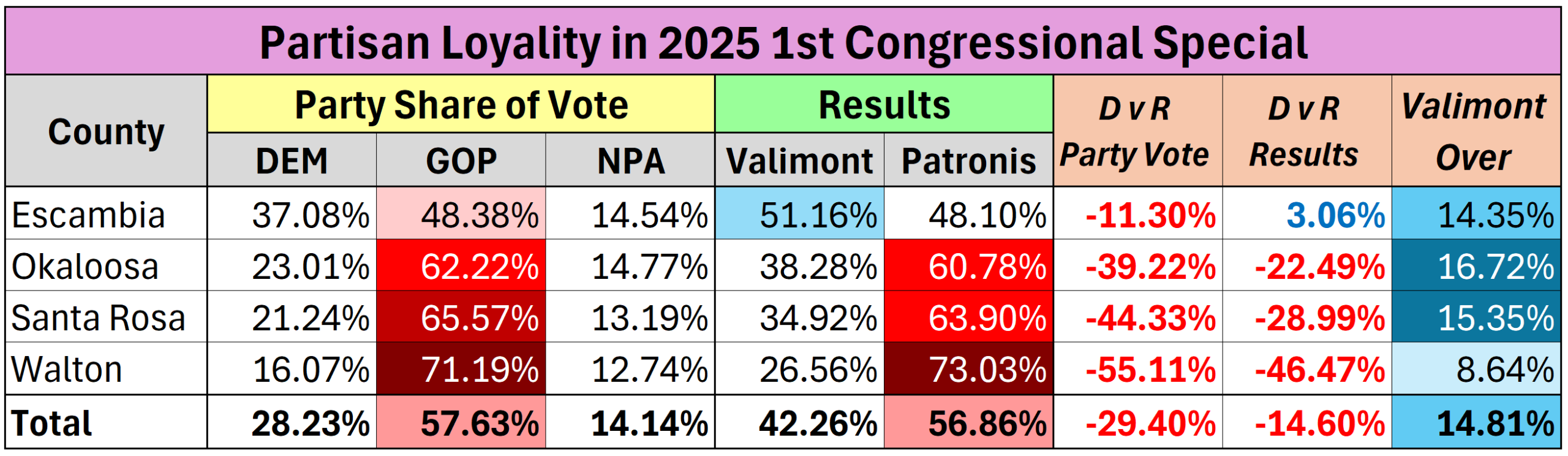
It should be especially noted that Patronis’ % of the vote did not even match the registered Republican % of votes cast in three of the four counties. Valimont here not only won large numbers of NPA voters, but she had to have won a good chunk of Republicans to over-perform by as much as she did. You can see these party loyalty scores broken down by precinct below.
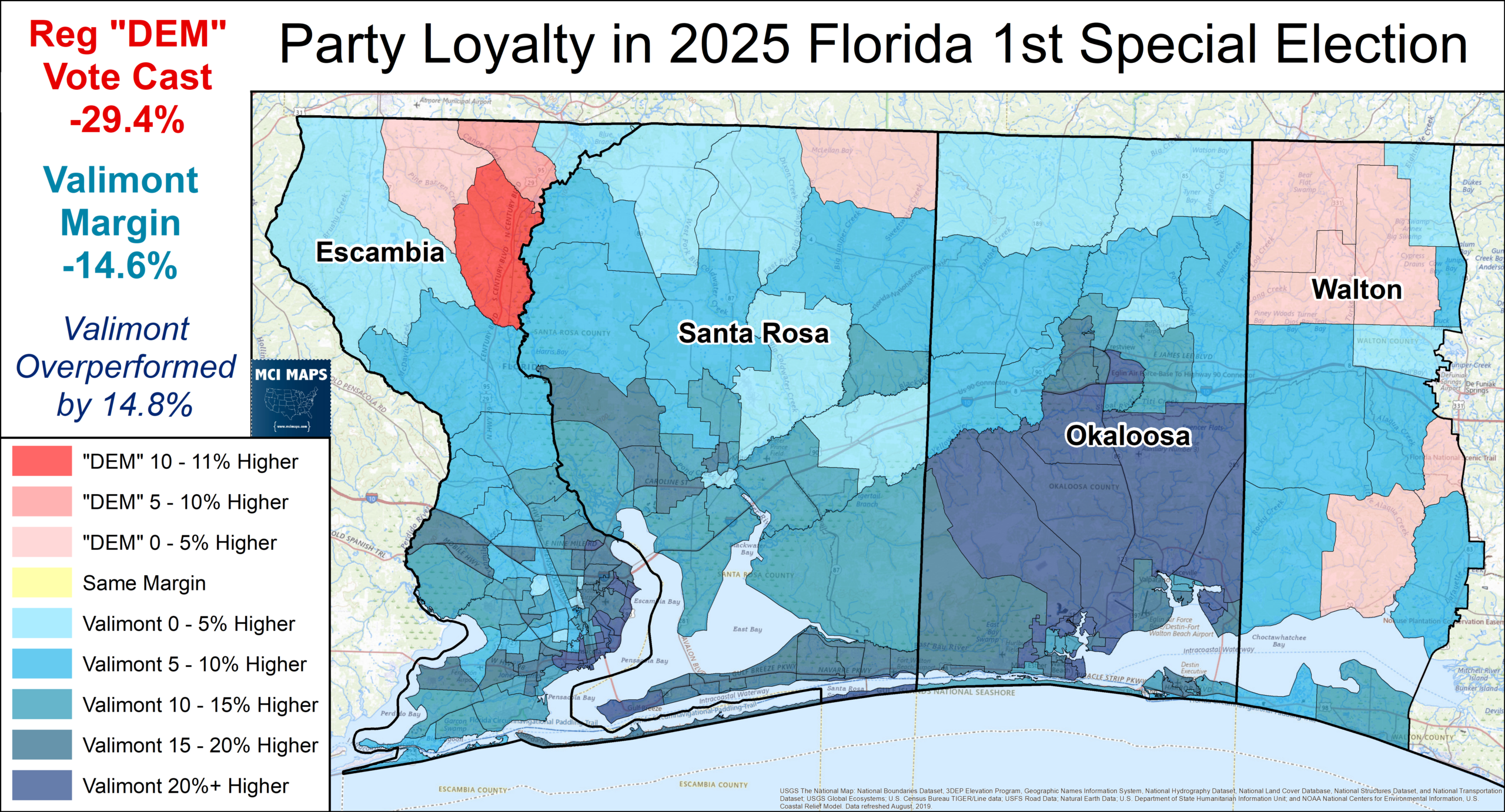
Valimont had massive over-performances in military areas and suburbs across the districts. Even in many rural communities she still greatly outperformed party metrics. Only a few rural precincts, likely the home of old conservative Democrats, saw Valimont do worse than party metrics.
Congressional District 6
At the same time voters in the 1st District were going to the polls, a special election was also being held in the 6th Congressional. This seat, based around Daytona, was another firmly Republican district. It voted for Donald Trump by 30 points, with the last Democrat to win it being Bill Nelson in 2012.
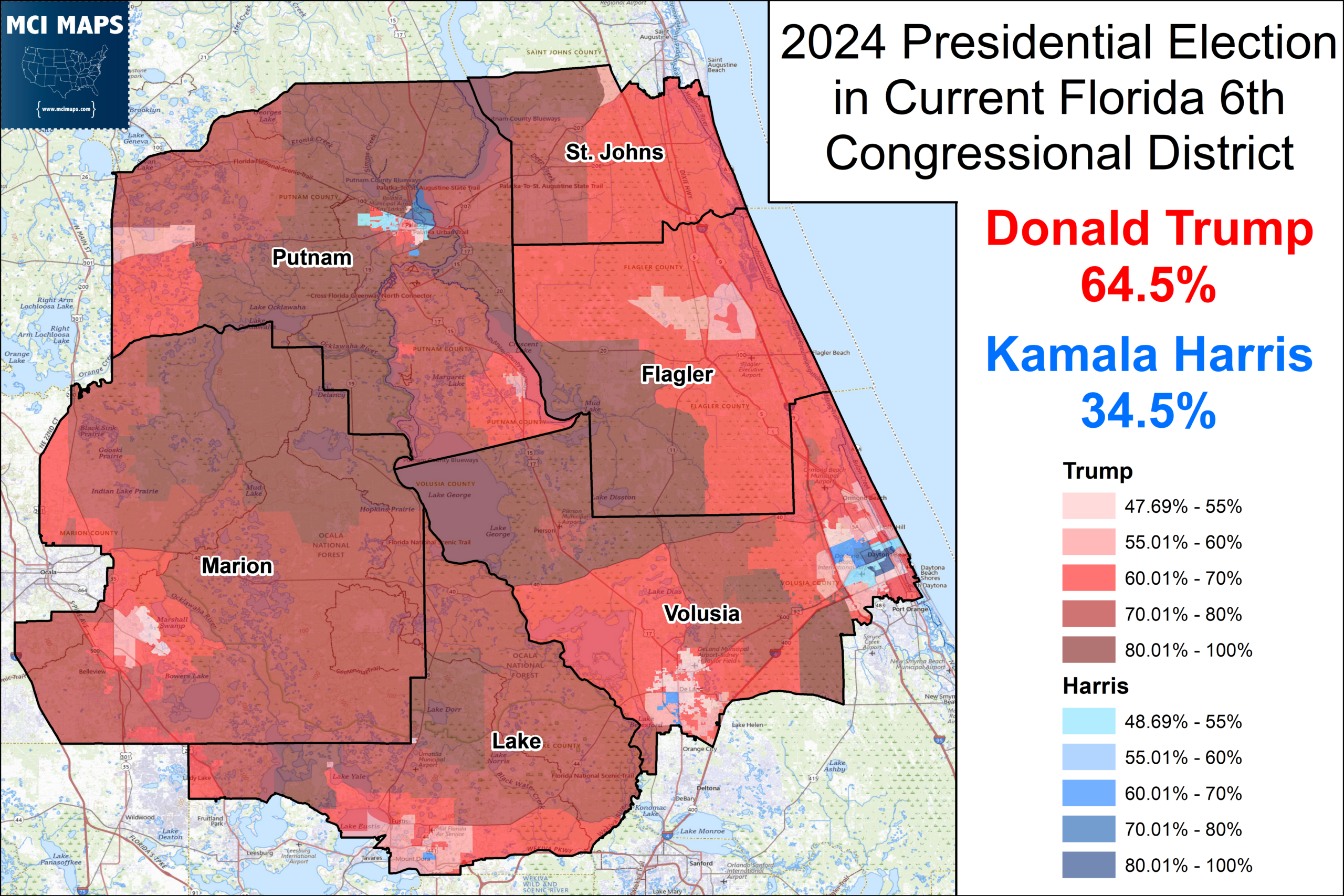
The seat opened up due to Congressman Mike Waltz being tapped to be Trump’s National Security Advisor, a role he held for 4 months before being fired and shuffled off to be UN Ambassador. When Waltz was tapped, Trump quickly endorsed State Senator Randy Fine to run for the post. Fine faced no real primary threat, even less so than Patronis, easily winning the nomination.
Like Patronis, Fine didn’t live in the district; having just been elected a State Senator for Brevard county. If you have ever seen Randy Fine on the news, you know that he is a lightning rod of controversy. In short, Fine is an arrogant, abrasive, bigot – directing his horrible rhetoric at Muslim and Arab populations more than anywhere else. In recent years he’s also rampt up anti-LGBT sentiment. I covered many of his controversies in my 2024 Primary Preview article (go to Senate 17 section). He is known to use his power in the legislature to threaten businesses and organization. He’s been dubbed “The Bully of Brevard.” You can also go back to my Congressional special preview for even more on his behavior.
Fine’s nasty views and his vindictive nature ensured he would have some struggles on the campaign trial. He’d burned his relationship with Governor DeSantis down; with both men coming to despise eachother. Fine did struggle as the campaign went on, with national Republicans becoming worried about his ability to win in the final month of the campaign.
Fine’s opponent was Josh Weil, who raised over $9,000,000 for the contest and latched onto the many controversies of Fine. However, Fine did benefit from the fact that Weil himself was not an especially strong candidate. Weil was brought under scrutiny for past legal troubles and the fact he is apparently drawing a salary from his own campaign. The broad spending of the Weil campaign also concerned many Democrats, which include spending over $50,000 on a high-end Air BNB for a campaign office and an insane amount of money going to consultants. Weil also ran as an avowed left-wing candidate in a district that was still very Republican.
More so than with Patronis, the Republican Party had to come in to help Fine out in the final weeks of the campaign. Attacks on Weil aired nonstop and a major GOP turnout drive was initiated. This allowed Fine to secure a 14% win.
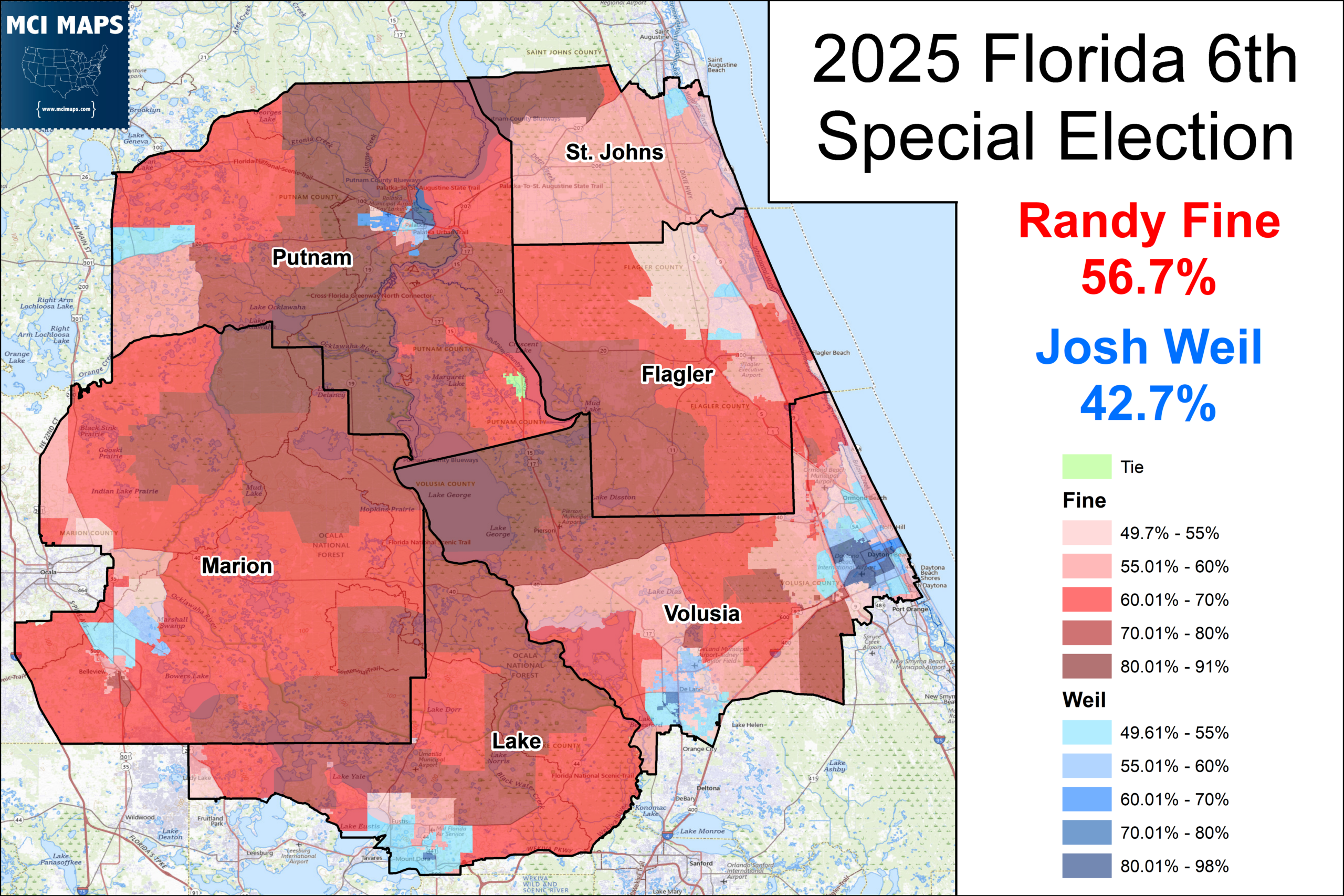
By the end of the campaign, faith among the GOP in Fine was so low that the 14% win managed to be viewed as a success. In the closing weeks of the campaign, many Republicans believed they would win, but that the margin would be in the single digits range.
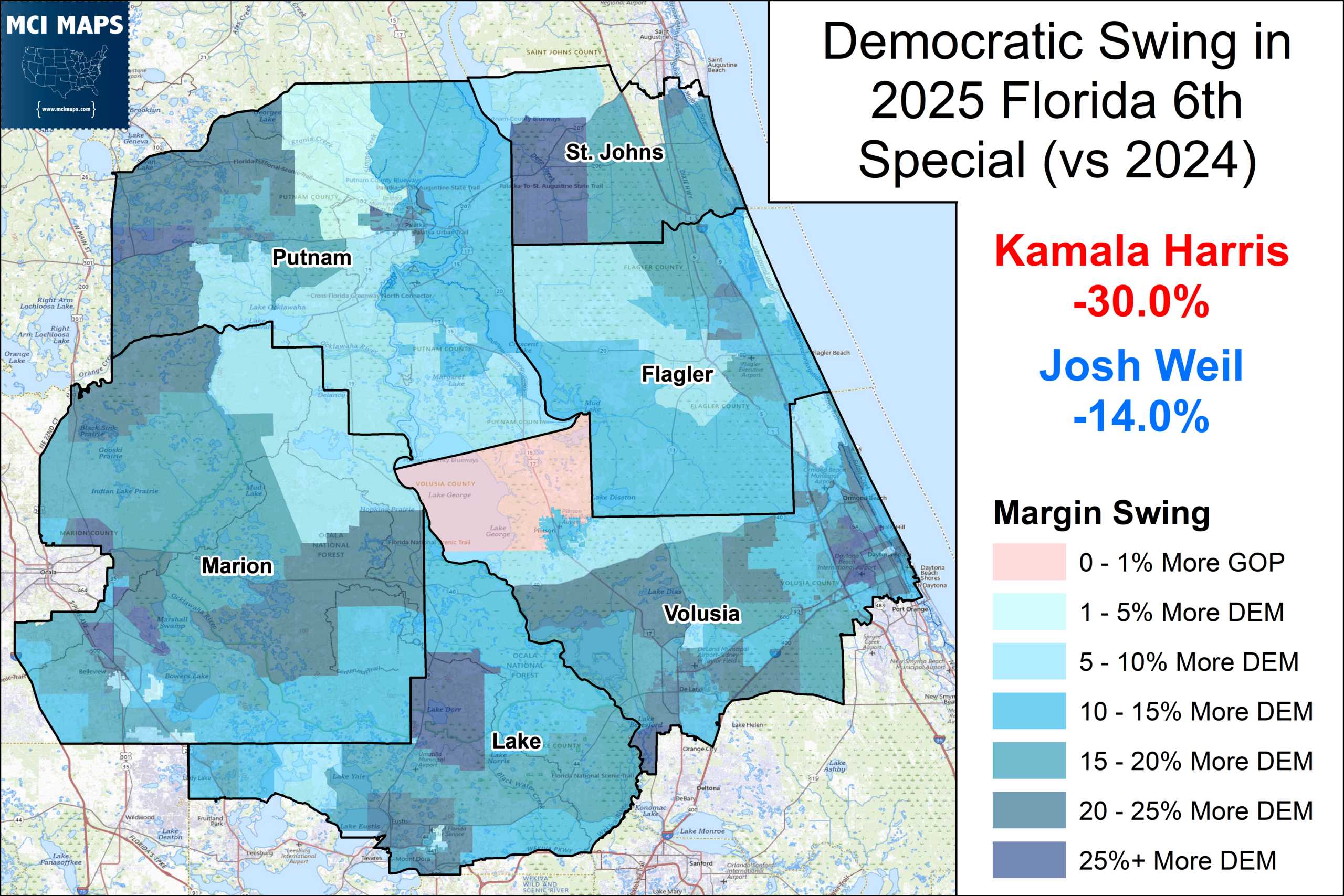
The results represented a 16 point swing away from the 2024 Presidential margins. Weil outperformed Harris in every precinct save for one.
Turnout was strong for both parties, the highest of any special election to be held the whole year. Democrats maintained the turnout edge, getting 43% of their voters to the polls versus 38% of Republicans; but that turnout gap was closer than it was in the 1st Congressional.
Weil, similar to Valimont in the 1st, outperformed the party metrics in his district. His 14% loss came amid a 21% GOP edge in votes cast. This came out to a lower party over-performance than Valimont, reflecting Weil’s weaker candidacy and the Republican efforts at the end of the campaign.
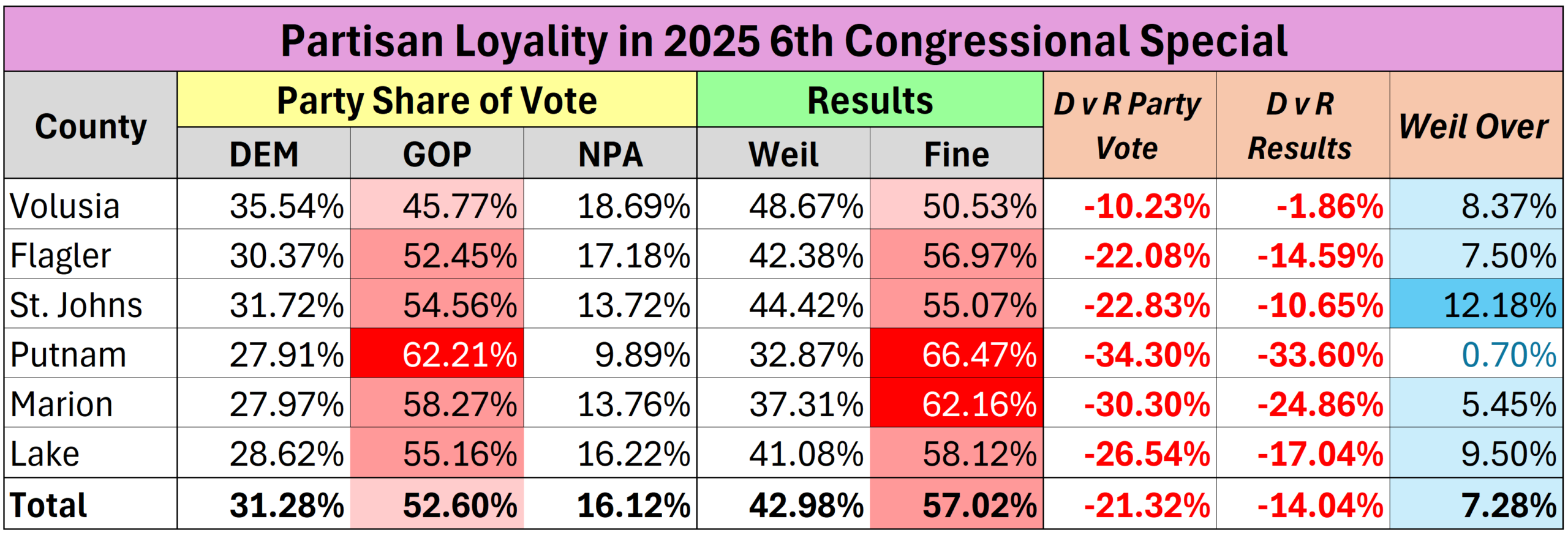
The county by county party loyalty score reveals the distinct communities of the district. St Johns, the most educated and suburban part of the district, had the largest over-performance. Meanwhile Putnam, home to some remaining conservative rural Democrats, erased Weil’s wins with independents. You can see the party loyalty by precinct below and see the rural/urban divide.
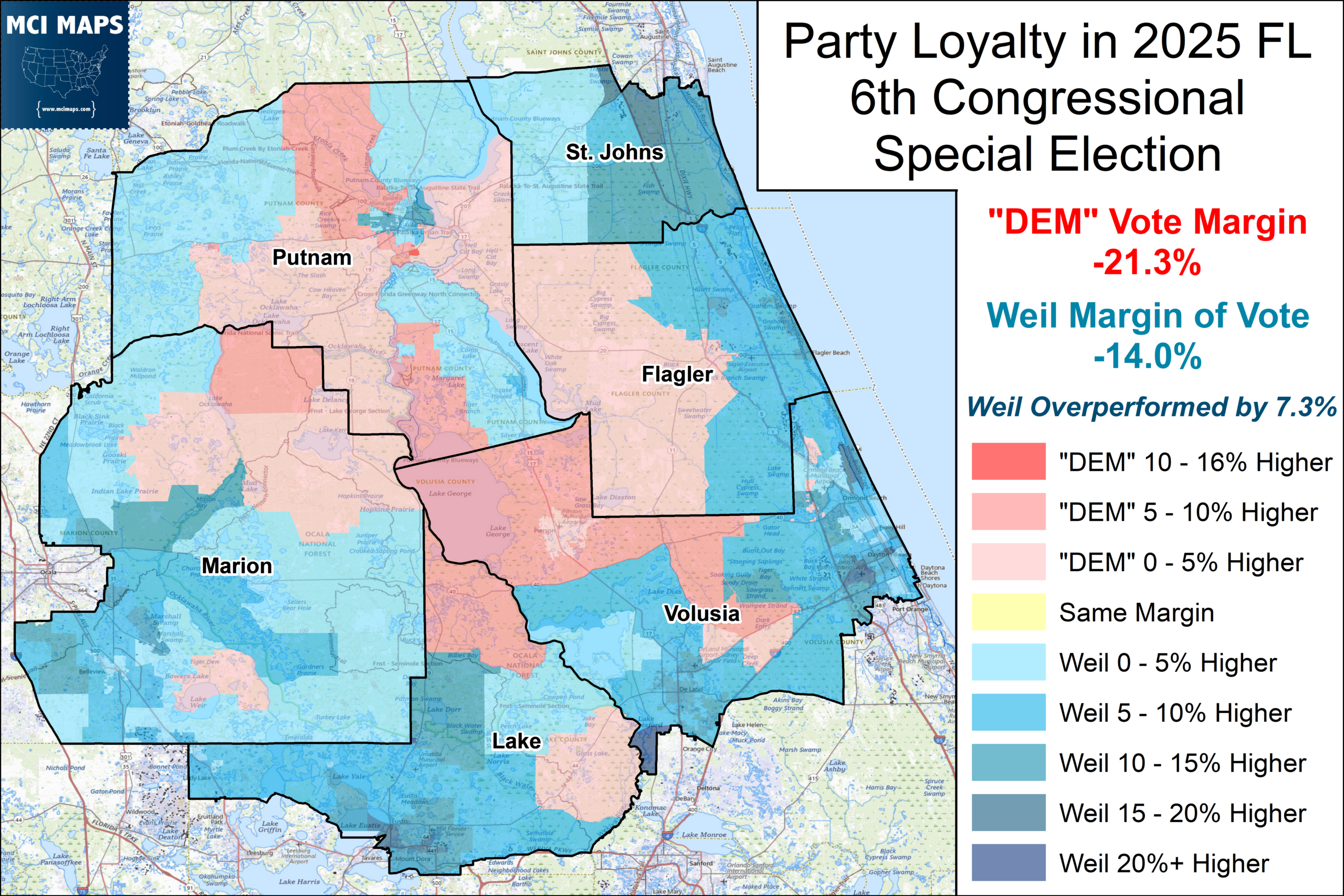
Weil did very well considering the Republican investment at the end. However, he struggled more than Valimont due to past issues. That said even a Valimont-level over-performance would not have been enough to flip the district. It was simply too red.
After the two Congressional specials were over, the national media moved on from Florida. However, several additional special elections took place, all for state legislative seats. Lets look at those now.
June’s Special Elections
On June 10th, three steady Republican districts held special elections. All of these were apart thanks to resignations stemming from the Congressional races we just discussed. None of these general elections generated much focus. However, they were all subjected to contentious Republican Primaries that took place in April 1st, the same day as the Congressional general elections.
State House 3 Primary and General
Back up in the panhandle of Florida, Joel Rudman had to resign his State House seat to run against Patronis in that ultimately doomed primary bid. This triggered a special election for what is easily one of the most Republican districts in Florida. In the 2024 election, Donald Trump won the district with 77% of the vote. Even in the Valimont performance in the 1st Congressional Special, the seat went for Jimmy Patronis with 66%.
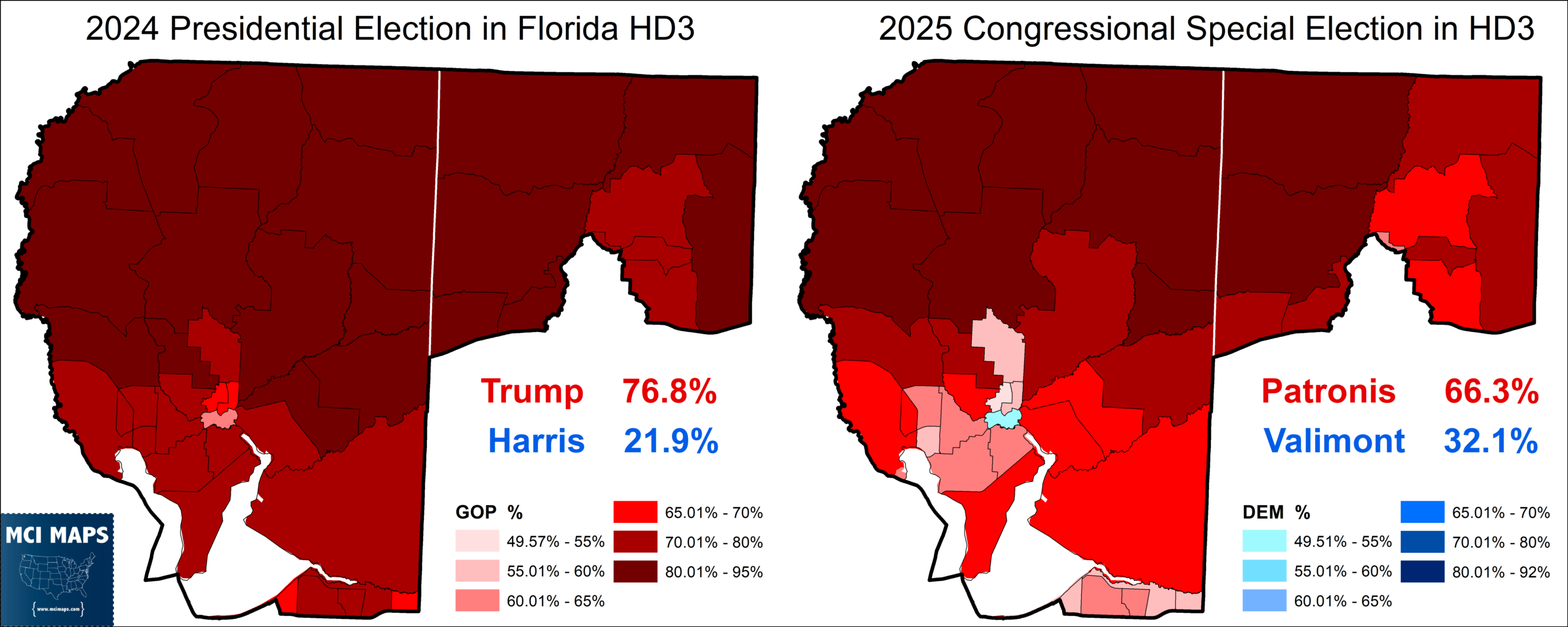
In this race, the real contest was the Republican Primary. A total of EIGHT Republicans entered the contest.
While the race was largely a contest of personalities, it did have a core theme of county representation. You see, while the district includes Santa Rosa and Okaloosa, the Santa Rosa portion represents over 80% of Republican voters. As Okaloosa has a separate state house seat in its southern end, Santa Rosa officials clamored that the seat needed to be held by a Santa Rosa resident. I discussed this dynamic in more depth at the end of this article looking at the Congressional specials.
The issue for Santa Rosa was that more serious candidates from their county entered. Meanwhile, Okaloosa had a clear standard bearer for their county. The two most prominent candidates were…
- Nathan Boyles (Okaloosa County)
- Former County Commissioner until 2024
- Raised $150,000
- Endorsed by Jimmy Patronis
- Endorsed by Okaloosa County officials
- Backing of area lawmakers and Sheriffs
- Shon O. Owens (Santa Rosa County)
- Mayor of Jay, FL
- Raised $80,000 and loaned another $40,000
- Backing of all Santa Rosa County Commissioners
Owens ran on being the Santa Rosa candidate, but he suffered from the presence of Assistant State Attorney Hayden Hudson, a Santa Rosa resident with the backing of Joel Rudman. Conservative activists Cynthia Smith also came from Santa Rosa as did veteran Jamie Lee Wells. Businessman Wade Merritt came from Okaloosa, as did assistant District Attorney Joshua Sik.
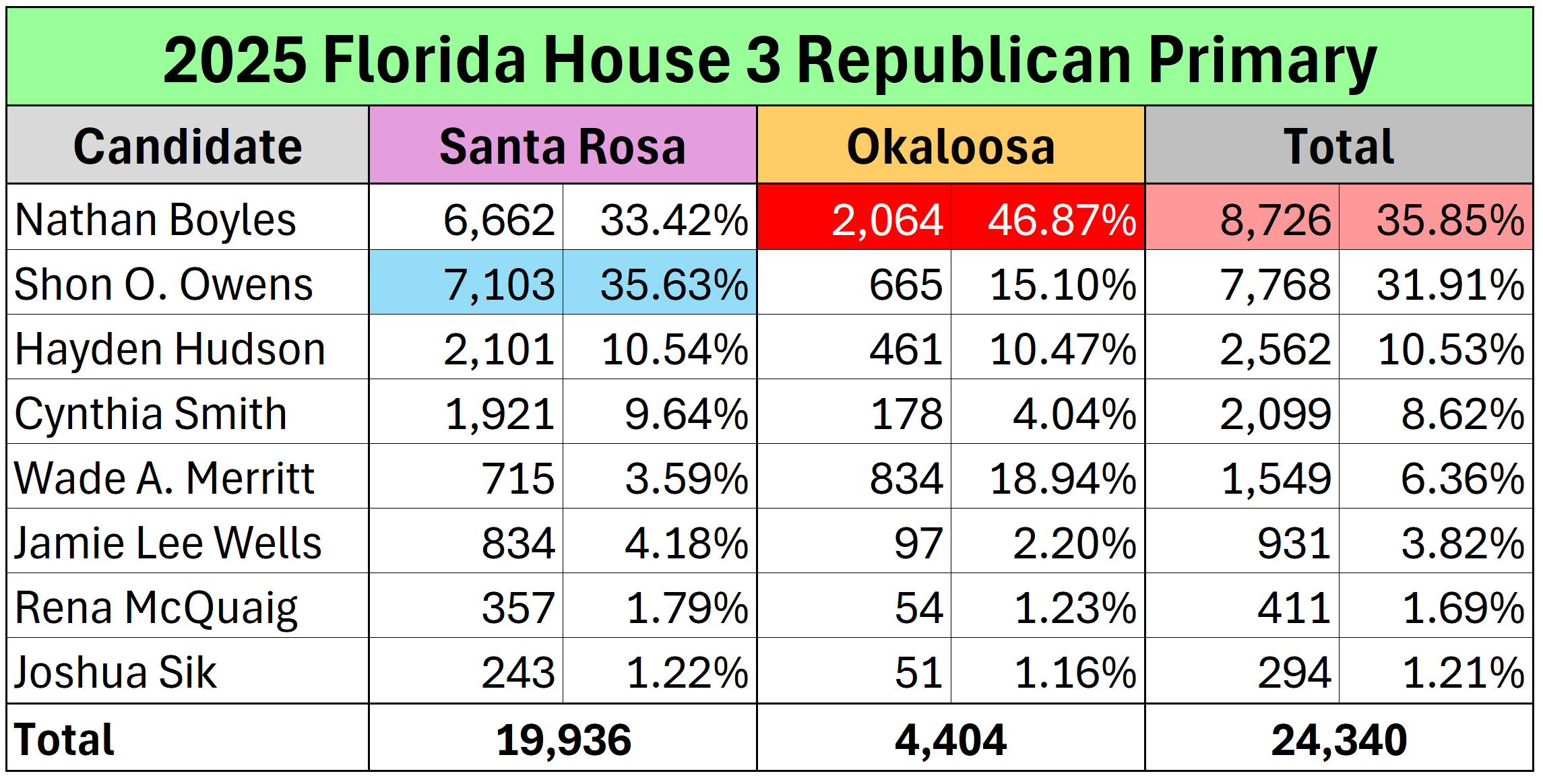
The final results saw Boyles edge past Owens, giving Okaloosa the win in the primary.
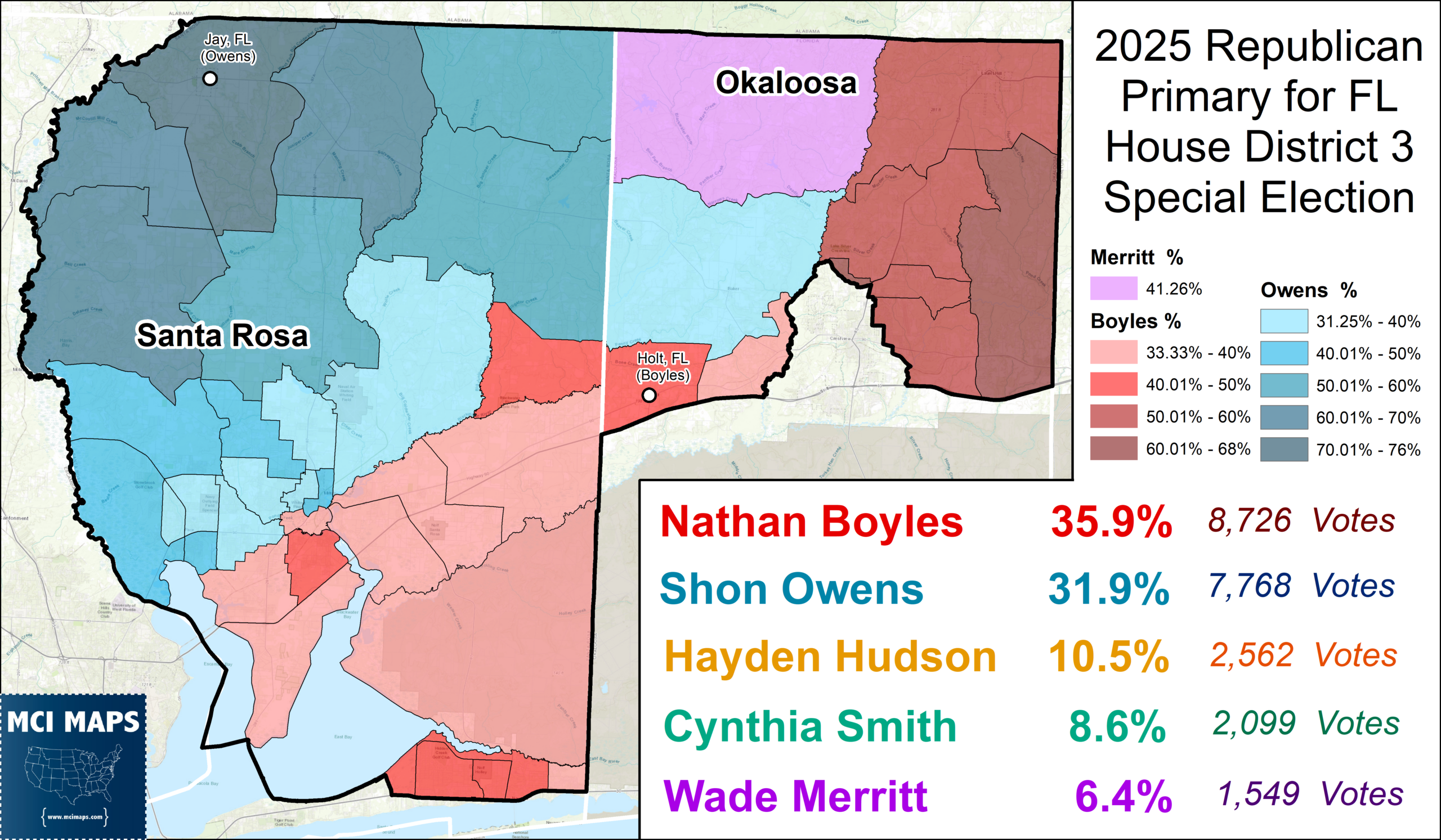
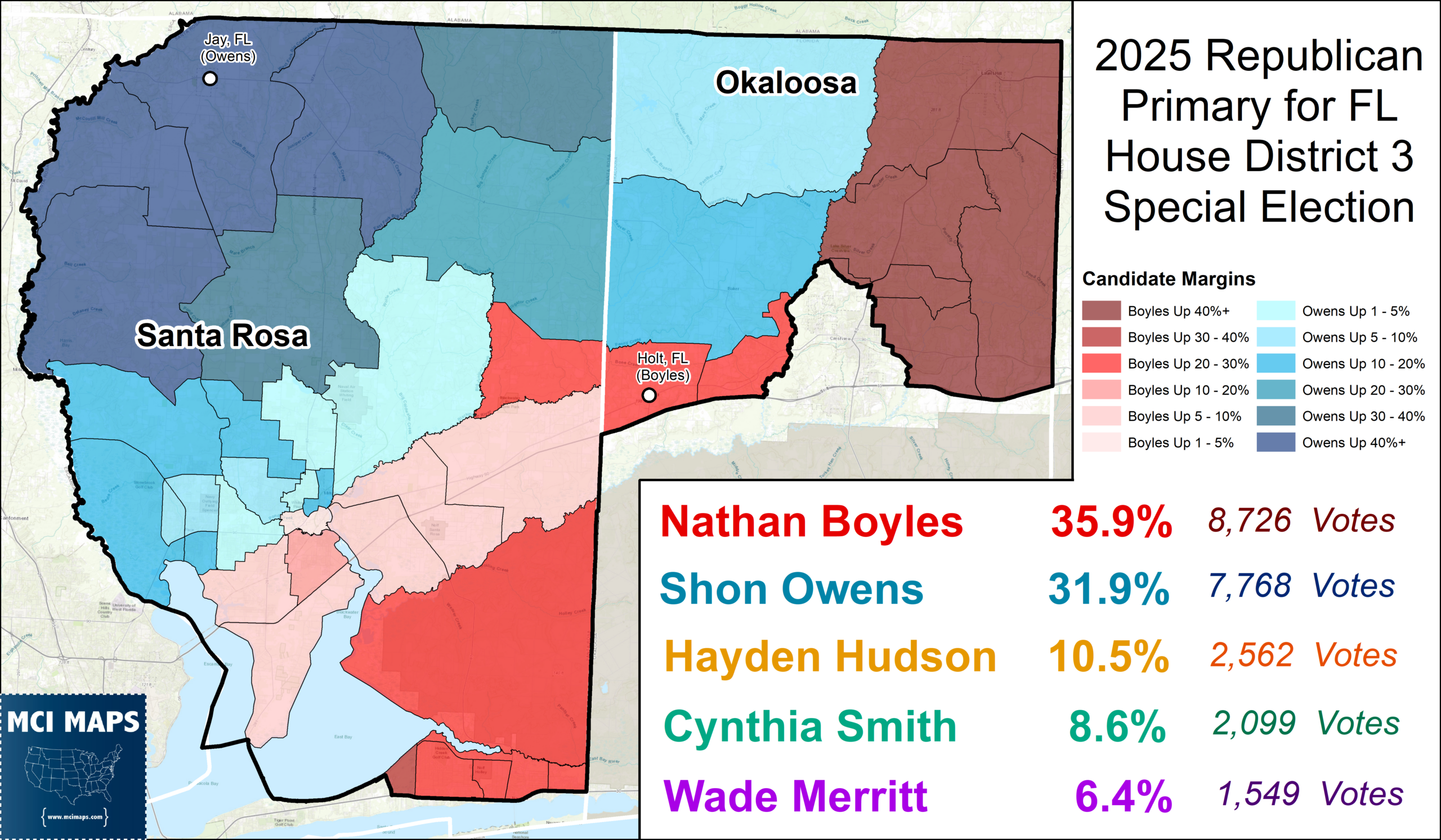
The geographic divide of the vote is especially remarkable. Boyles’ key to victory was the massive margin over Owens in the east end of Okaloosa and his ability to win southern Santa Rosa. Owens, meanwhile, had a massive base in the Jay community he lead, and broadly did well in the northwest end of the district. While Santa Rosa dominated the vote total, that vote was divided. Boyles managed to secure a solid 33% in Santa Rosa while also winning big in Okaloosa. Owens lagged much further in Okaloosa.
Another look at the primary vote can be seen below; comparing the Boyles and Owens margin relative to eachother. The district has a perfect regional divide – with Owens winning the Northwest rurals and Boyles dominating east Okaloosa and taking southern Santa Rosa.
With Boyle the nominee, he eventual elevation to State Representative was a guarantee. There is no scenario where this seat would go Democratic. Its just that red. Despite this, Boyles has still put some effort in. He’s raised $60,000 for the general. His Democratic opponent, Dondre Wise, meanwhile, never even filed a finance report for his last two deadlines. Before then, he’d raised $6,000. Wise does not even live in the district, residing in Escambia County instead.
The lack of campaign for this race led to the lowest turnout of the year – just 8.7%. However, even here Democrats outpaced Republicans, with 19% turnout vs the Republicans 8%, the biggest turnout gap of the year! It shows how the enthusiasm gap exists regardless of campaign aggressiveness. Of course none of that mattered, as the district went to Boyles. However, there was still a massive 20% over-performance.
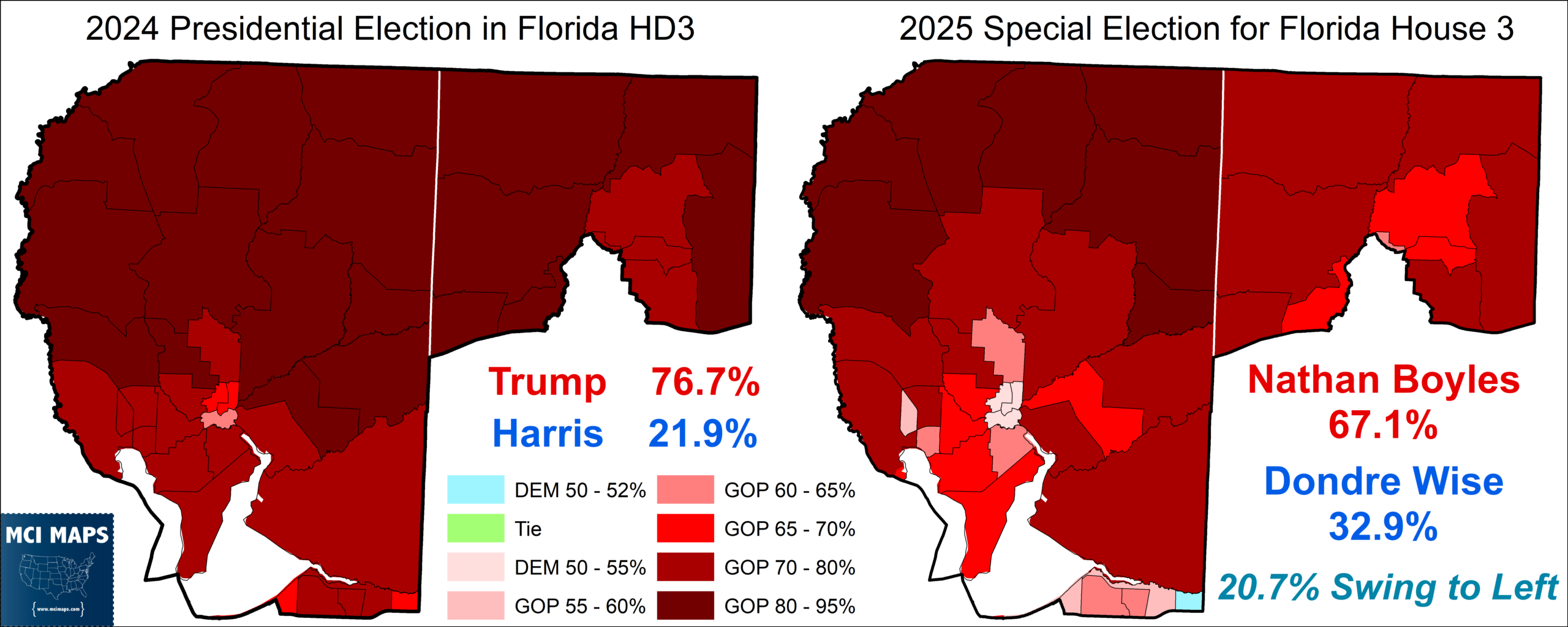
The fact that Dondre Wise managed to outperform by 21 points is a real testament to the mood among the electorate.
It wasn’t just turnout either, as Wise out-performed the party loyalty metrics, losing by 34% in a GOP +43% electorate. This was not Wise’s doing – as his campaign is now subject to audit for never filling financial reports to close out the account. It was a testament to the mood of the electorate.
State Senate 19 and State House 32
Down in Brevard County, two legislative contests coincided with the race for House 3. These were triggered by Randy Fine running for Congress, leaving his State Senate seat open. It was quickly announced that State Representative Debbie Mayfield would run for the Senate, meaning her house seat would also need a special election. Both districts voted for Trump by right around 20 points.
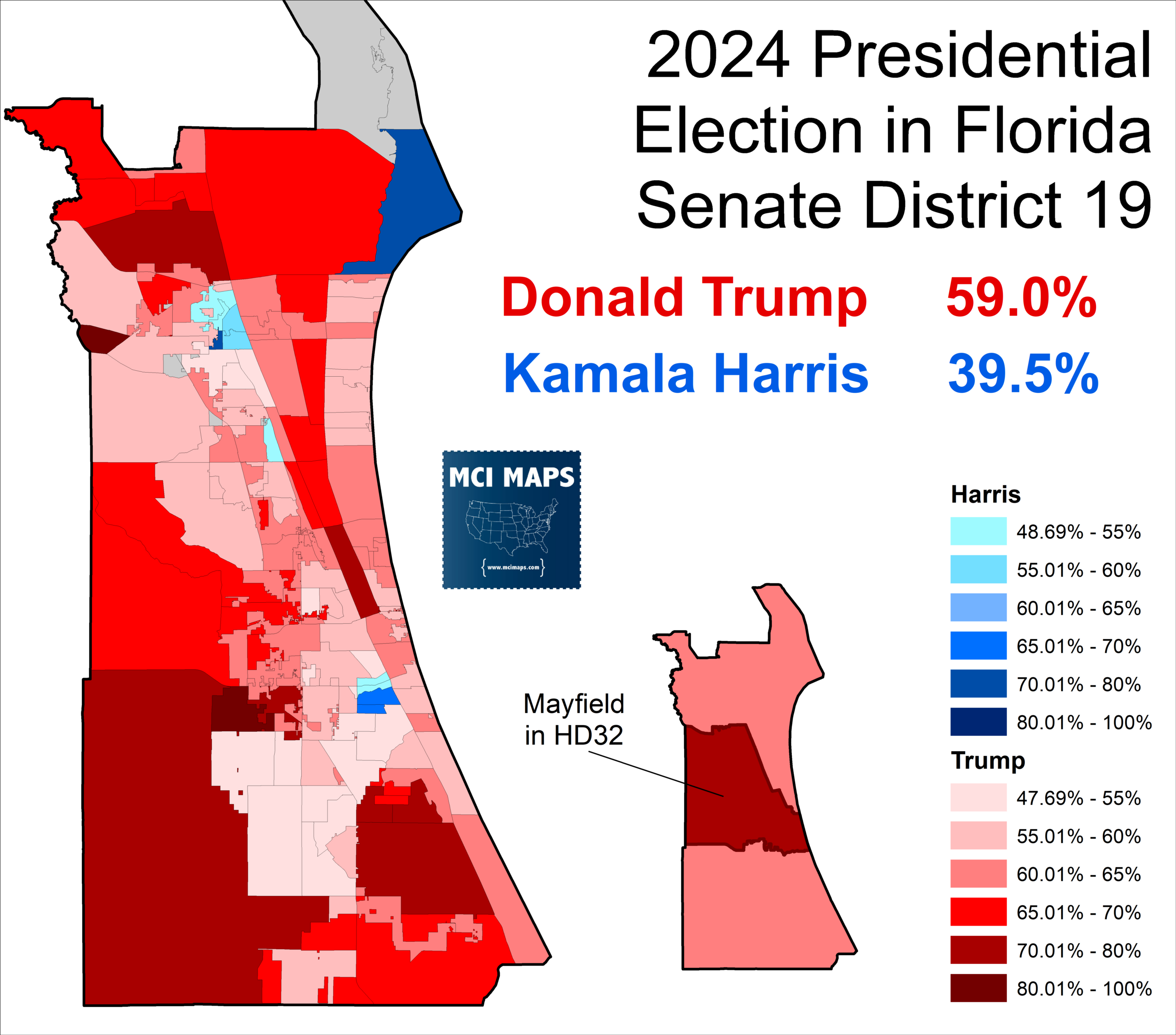
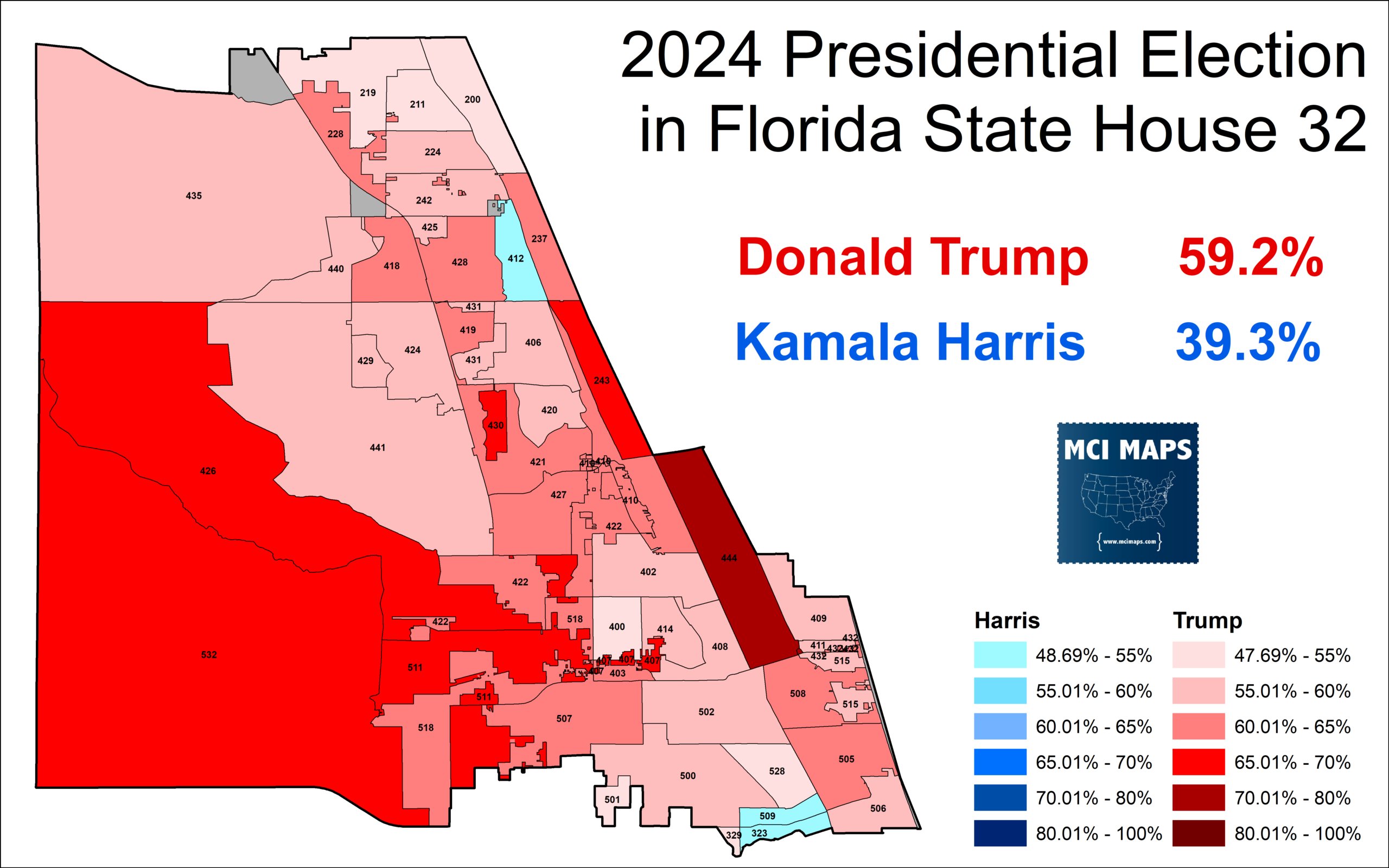
Both contests were expected to be Republican holds. The big drama would play out in the Republican Primaries. On the State Senate side, drama absolutely reared its head.
The Republican Primaries
Shortly after Randy Fine announced he’d be running for Congress, State Representative Debbie Mayfield announced her bid for the seat. Mayfield had a long history in the region, serving in the State House from 2008 to 2016 and then in the State Senate from 2016 to 2024. Then she won election back to the state house that year. This all stemmed from Florida’s term limits rules, which have banned anything past eight consecutive years in either the House or Senate, but no lifetime ban. Mayfield was termed out in 2024 from the State Senate, but she was able to run for the State House because it was a different office. Through all of this, the voters of the region continued to support her. In 2024, she was the strongest performing Republican in a State House contest, outperforming Trump by 5% in the district. Mayfield was allowed to run for State Senate again because her last eight year term had ended in November of 2024. If elected, she would take office in June of 2025, a break that reset the term limit. Is this violating the spirit of term limits? Yes.
Mayfield was a clear frontrunner for the primary the moment she announced. However, Governor DeSantis and her did not get along and he tried to recruit someone to run against Mayfield. Scandal emerged during qualifying in February. Mayfield submitted her paperwork for the State Senate, with no serious candidate emerging against her in the primary. However, at the last moment, Melbourn City Commissioner Tim Thomas switched his filing from the State House contest and moved to file for State Senate. The day after, Secretary of State Cord Byrd said he could not approve Mayfield’s paperwork and argued she was in violation of term limits.
The move was scandalous, as it was generally agreed that Mayfield was NOT in violation of the law and that Byrd’s role was entirely clerical, and he was not allowed to make such a legal decision. Byrd, a strong DeSantis ally and appointee, was seen as doing this on behalf of the Governor. I documented the entire saga in this article. The move ultimately failed, however, as the Florida Supreme Court promptly rejected Byrd’s argument, ruling 7-0 he had no authority to make the move and they restored Mayfield’s candidacy. With Mayfield back in the race, money and support from the Governor to Tim Thomas never materialized. Mayfield would go on to win a 4-way Republican Primary with 61% of the vote, a race I discussed in more detail here.
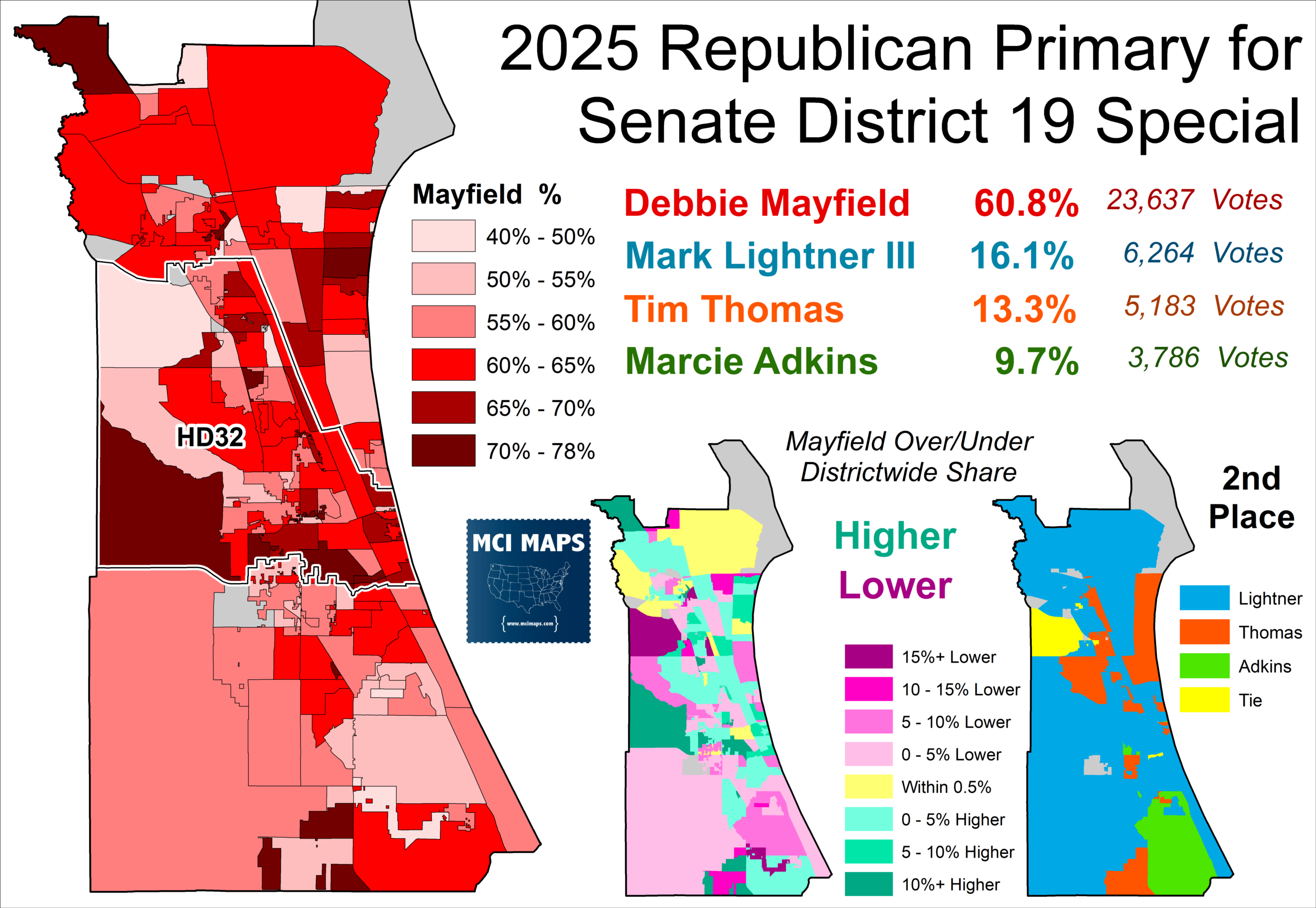
Once the court had decided to put Mayfield back on the ballot, that entire primary became a sleepy affair. However, the primary for Mayfield’s State House seat generated far more attention. I also covered that race in more detail in the middle/end of this article; but I’ll cover the key points here.
The race was a three-way affair with candidates each spending a good deal of money. First up is dermatologist Terry Cronin, who has raised $145,000 and loaned his campaign another $235,000. Cronin had the backing of folks like Senator Randy Fine. Then there was insurance man Brian Hodgers, who has raised $347,000 – with about $250,000 of that being money he gave to the campaign. The final candidate is Conservative Activist Bob White. The head of the Brevard Liberty Caucus, White has raised $40,000 but boosted his campaign with a $100,000 loan.
The result was a near perfect 3-way split, with all candidates earning different degrees of support. Hodgers, however, queezed out the win with 35% of the vote.
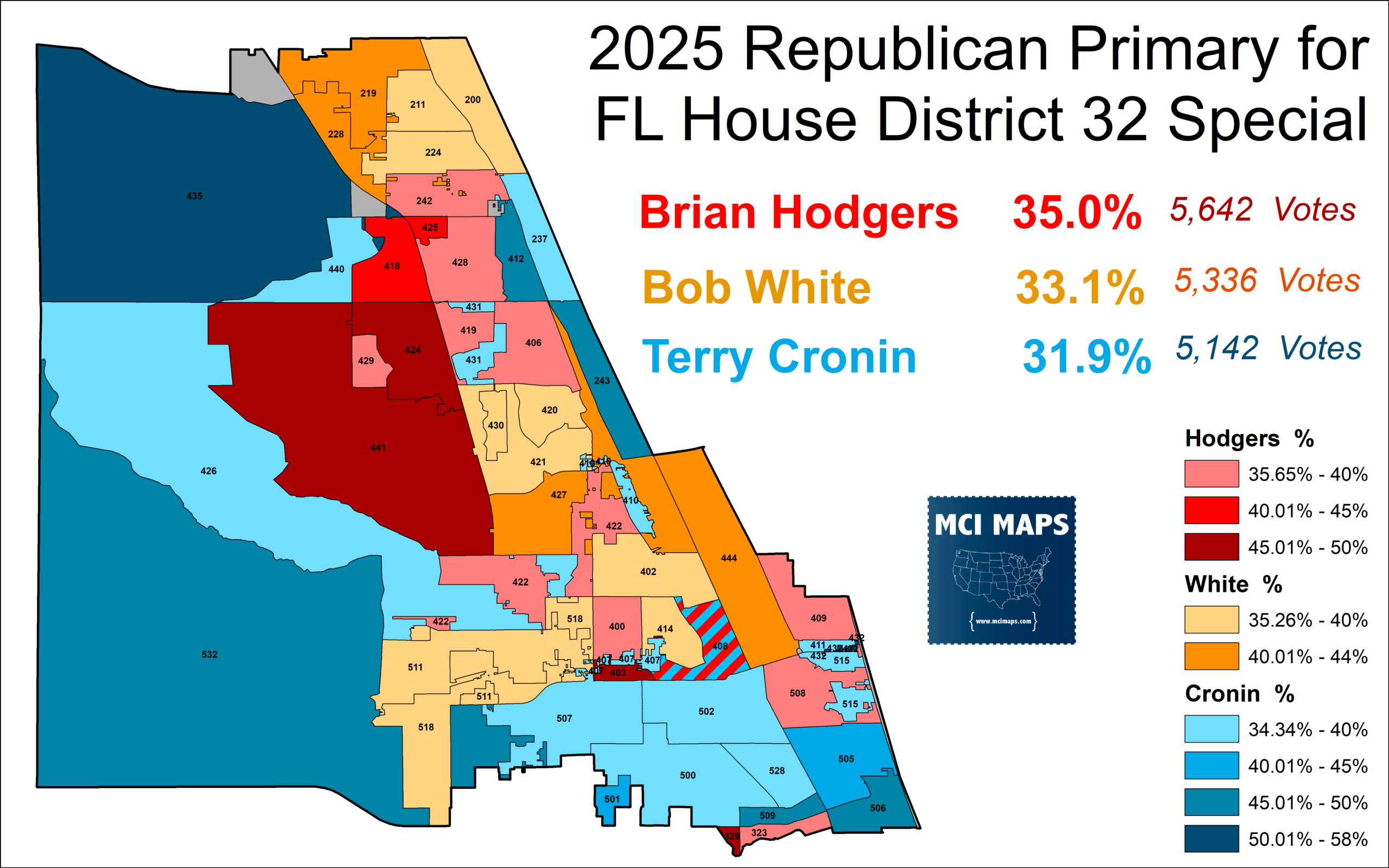
Once Mayfield and Hodgers were the nominees, both races were expected to remain in the Republican camp.
The Quiet General Elections
Both democratic candidates did not have strong financial resources. Mayfield’s opponent was Democrat Vance Ahrens, who ran against Randy Fine in 2024; getting 41% of the vote. Ahrens only managed to raised around $16,000. This was ironically more than Mayfield, as she was not allowed to raise money due to the ongoing legislative session (where she still served in the state house until election day). With Mayfield’s strong name ID and Republican committee money, this did not matter. Meanwhile, Hodgers raised $140,000 to fend off Democrat Juan Hinojosa, a 30-year military veteran, who raised just $4,600.
The general elections occurred the same day as the State House 3 contest. Both Mayfield and Hodgers secured between 54% and 55% of the vote.
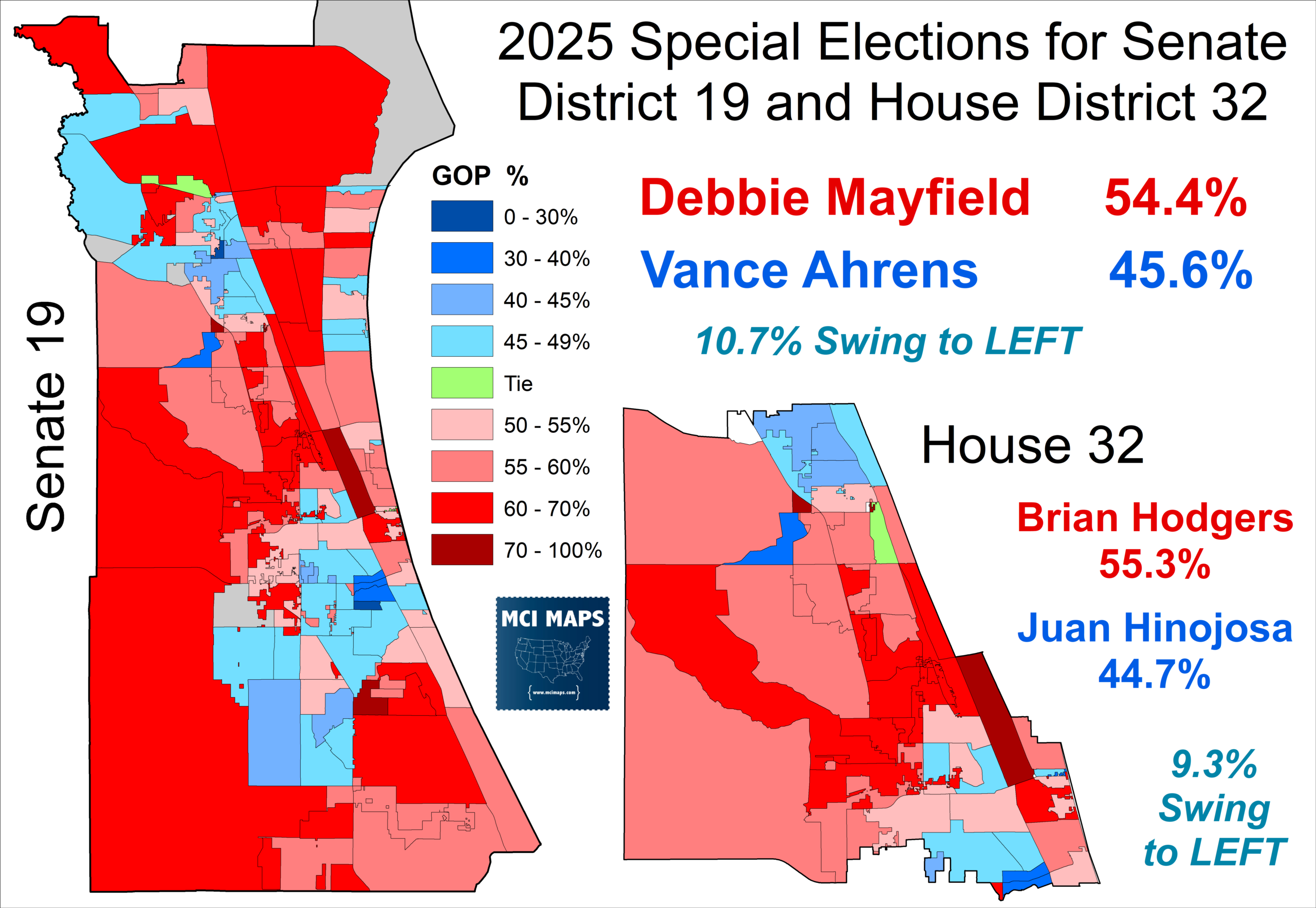
Both districts saw swings to the left. Each district had similar turnout dynamics, with Democrats turning out at a slightly higher pace despite having no major GOTV operation. Both democrats out-performed party metrics. In the House race, Juan Hinojosa lost by 10% in a +21 GOP electorate; a 11% overperformance. In the Senate race, Ahrens lost by 9% in a GOP +18 electorate; a 9% overperformance.
There was also little distinction between Mayfield and Hodgers in the precincts they both ran in. Within HD32, Mayfield got 55.7% of the vote while Hodgers was at 55.3%. Mayfield only got 147 more votes than Hodgers, a far cry from 2024 when she got 3,200 more votes than Donald Trump within the same district. In this special election, granted this being among a more politically-engaged crowd, Mayfield had no unique crossover support like she had in previous contests.
September’s Orange County Specials
Orange County voters had a special election that tragically came from an untimely death. Longtime elected official Geraldine Thompson passed away in February of 2025 after complications from knee surgery. Thompson was a titanic presence in Orlando’s Black community, with her and her husband being major figures in the region’s civil rights cause. Thompson did not enter elected politics until the mid 200s. She was elected to the state house in 2006, then served in the state senate, then back to the state house, and then in the state senate once again. I documented her history extensively here. That piece also has many more details on the chaotic Democratic primary I will be discussing in a minute.
Thompson’s State Senate seat was a heavily Democratic district that was drawn to unite the Orange County’s Black community. While the district was plurality white, its Democratic Primary was majority-Black. The Democratic Primary here was the key contest.
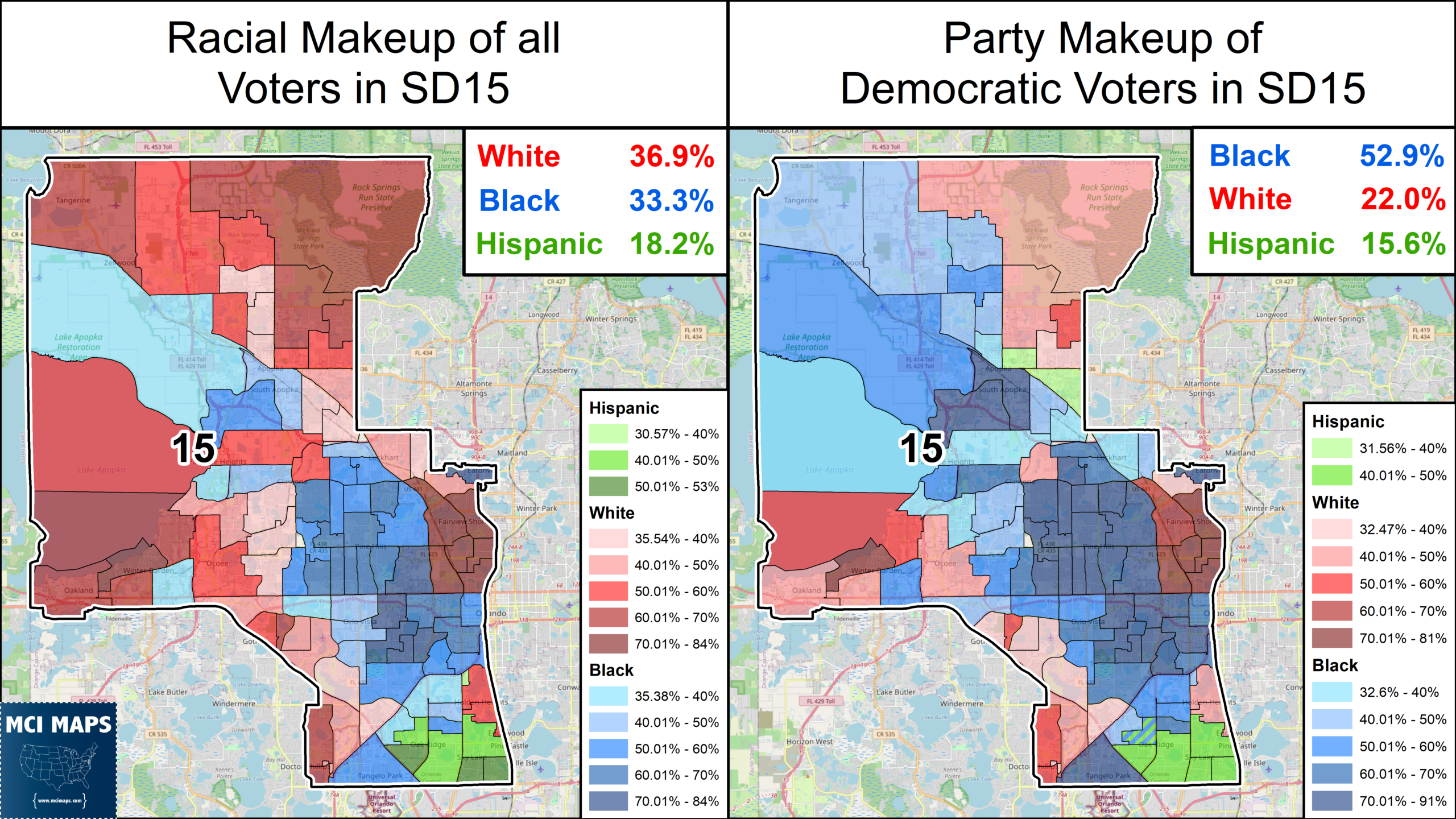
Shortly after Thompson’s passing, a clear Democratic front-runner emerged; Lavon Bracy Davis.
Lavon was elected to the majority-Black House District 40 in 2022 and with her run for the special election, her seat would also be up for grabs. Both districts were reliably Democratic.
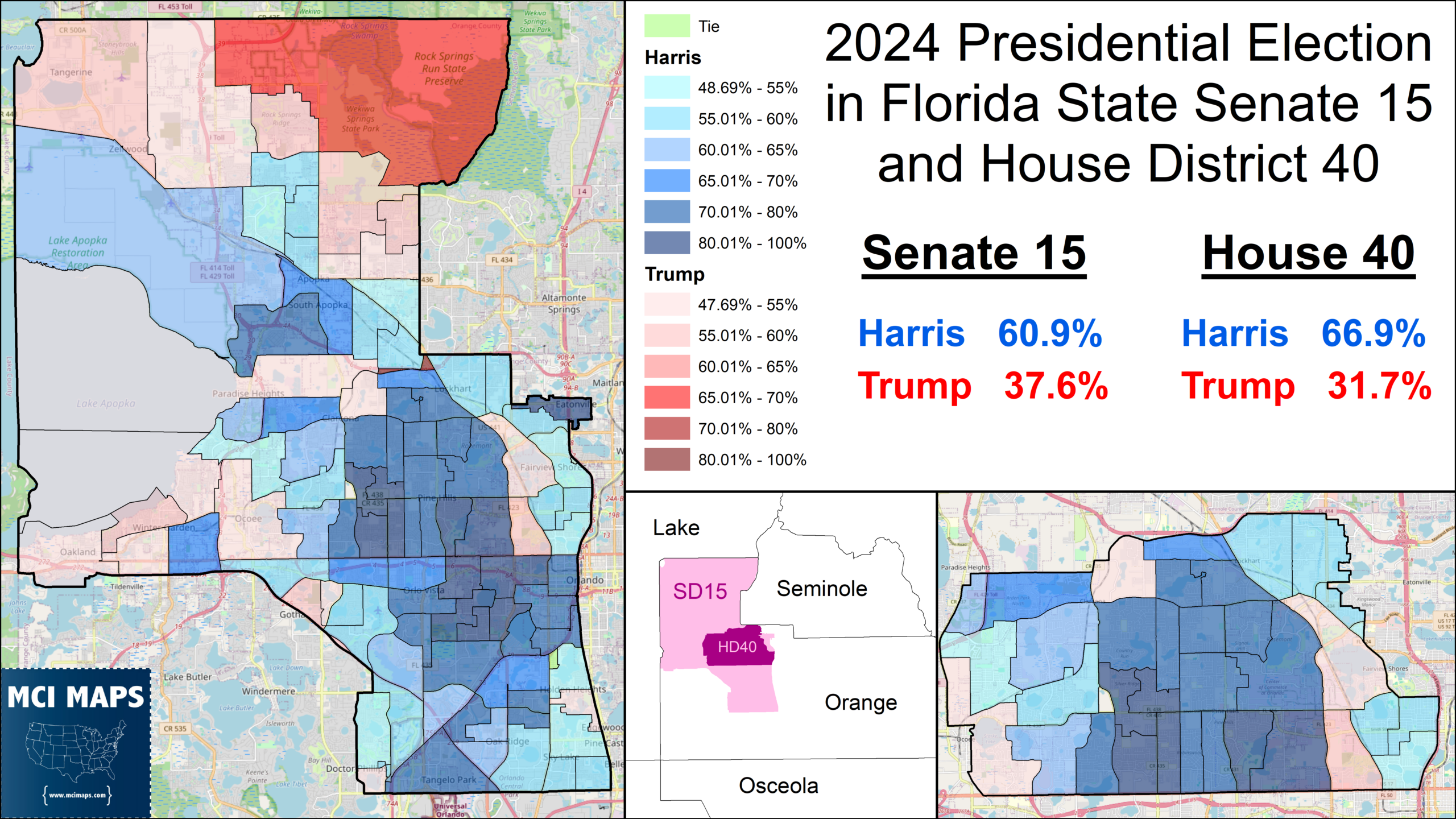
While both seats would have contested Democratic Primaries, the fight for Senate was much more intense and personal.
Senate 15 Democratic Primary
Lavon Bracy Davis came out of the gate with the endorsement of the Thompson family. In fact, the Bracy and Thompson families had strong ties dating back decades. Lavon’s mother, Dr. LaVon Bracy, was college roommates with Geraldine Thompson and was her maid of honor. Before her death, Thompson was a mentor to Lavon and indicated she wanted the state rep to succeed her when she retired. This instantly made Bracy Davis the front-runner for the seat.
The presence of two other candidates of considerable controversy and scandal made this race a very messy affair. First, Bracy Davis’ bother, former legislature Randolph Bracy, also entered the contest. Randolph had been a State Senator until 2022, when he lost a Congressional bid to Maxwell Frost. After this, Randolph decided to primary the Incumbent Senator Thompson in the 2024 Democratic primary; where he lost. I documented that race here. It was a scandalous race due to the Bracy and Thompson family long ties; with most standing firmly in the Thompson camp, many lamenting Bracy’s nastiness in the contest. He burned so many bridges that he had little support in the special election primary. On top of this, while Lavon only offered kind words for her brother, Randolph was openly bitter that his sister was running for the seat. You must go read my Thompson legacy/primary preview article for more on this crazy dynamic. But long story short – Lavon was in the right and Randolph is a jackass.
Another lightning rod of controversy was Alan Grayson, the former Congressman for central Florida. Grayson is a blast from the past, serving off-and-on in Congress from 2008 to 2016. He now is a perennial candidate running for offices off and on while largely self-funding. His brash personality and ethical questions tanked his career. However, he is such a colorful character I wrote a 5 Part Series on his Rise and Fall. This go around he self-funded his campaign with over $300,000.
The final contender was first time candidate Coretta Anthony-Smith, who self-funded her campaign by over $150,000. Smith ran under the banner of being a fresh face and above the drama of the family dynamics and former Congresspeople. There was certainty an argument she could do well by voters who were sick of the drama. This was likely Lavon Bracy Davis’ biggest concern. While Lavon avoided her brother’s attacks and drama, she risked getting pulled down by him.
In the end, however, Lavon Bracy Davis secured a primary victory in the district with 43% of the vote, followed by Anthony-Smith. Alan Grayson and her Randolph Bracy badly trailed. For both those men, it was the latest chapter in a long political decline.
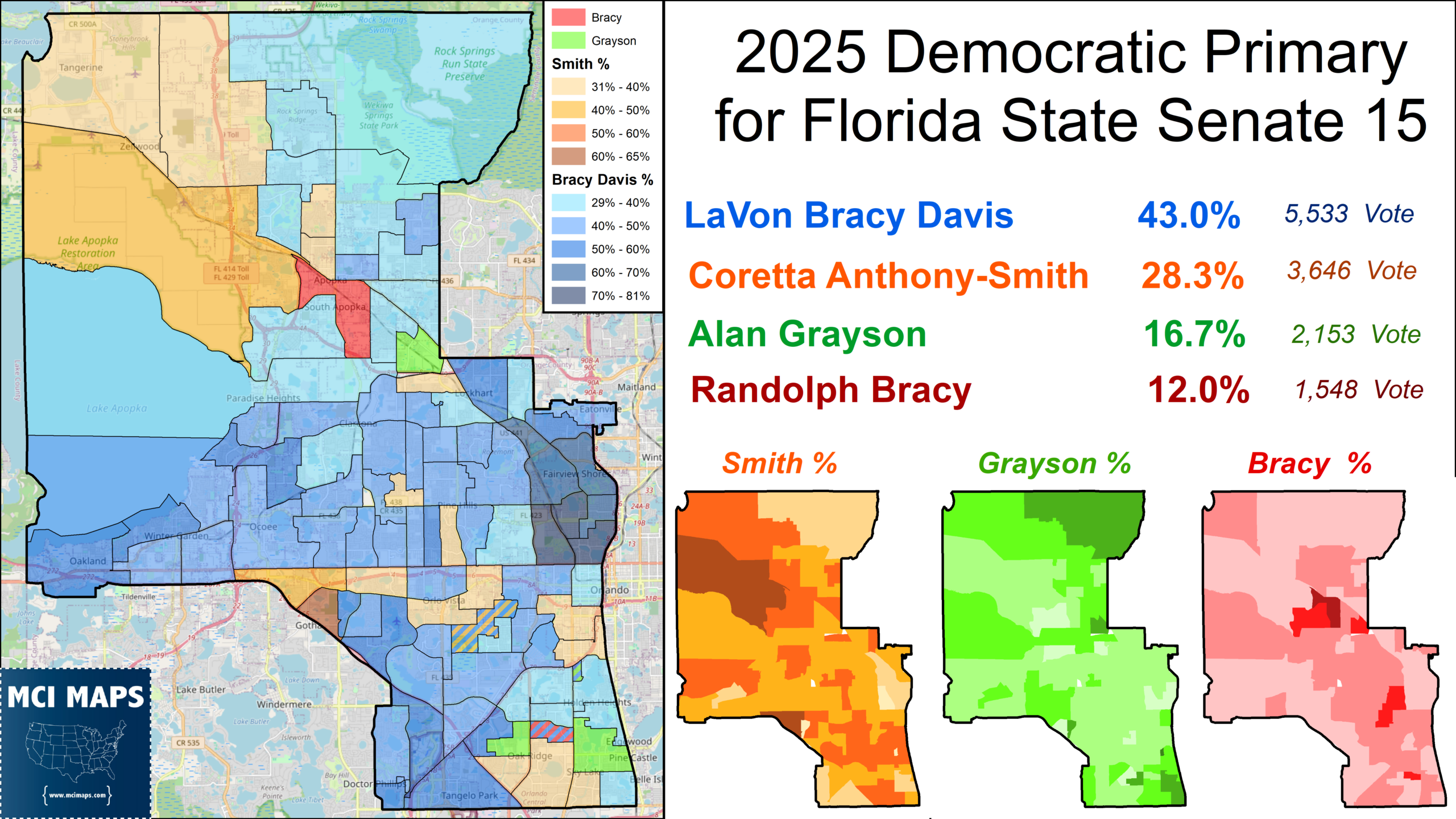
Smith had a strong showing for a first time candidate, potentially setting herself up for a future run down the line. Meanwhile, with Bracy Davis securing the nomination, her general election was all but a guarantee.
House 40 Primary
The same day as Bracy Davis won the primary for Senate, a primary was held for the house seat she was leaving. Here the race was far less dramatic. The establishment favorite was RaShon Young, the legislative aid to Bracy Davis. She came in with a batch of endorsements and managed to raise $75,000. Her opponent was former State House member Travaris McCurdy; who held a neighboring seat from 2020 to 2022. McCurdy had been elected unopposed in 2020, but lost re-nomination to former Democratic lawmaker Bruce Antone. Following this, McCurdy lost an election for Orlando city council, further weakening a comeback bid. While he had stronger name ID, he raised less than $15,000.
After a much quieter Democratic Primary than the one playing out in SD15, RaShon Young pulled off a 11% win.
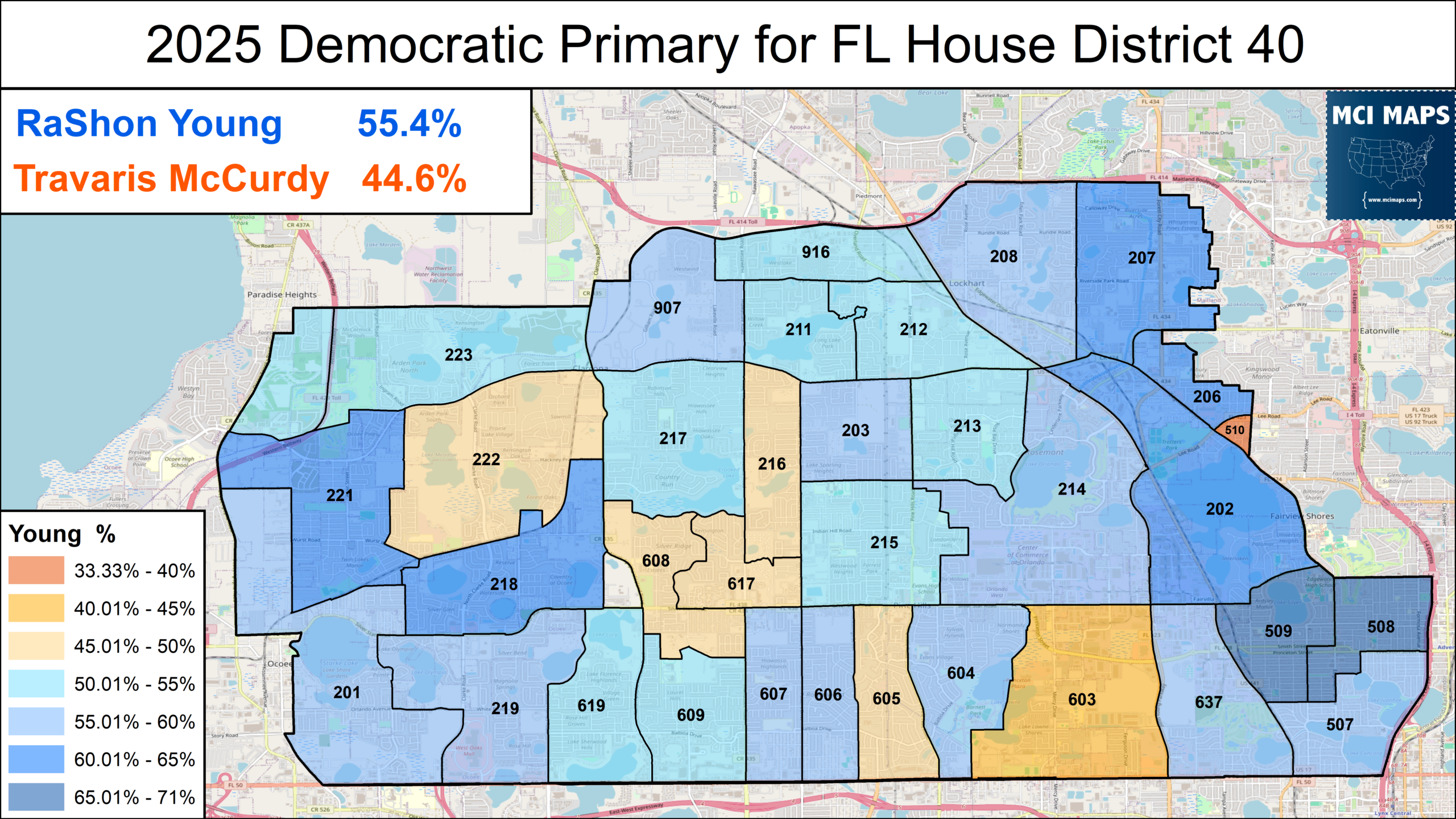
Same as with Bracy Davis, once Young was the nominee, the general was a formality.
General Election for SD15 and HD40
The September general elections were very quiet affairs. In the Senate contest, Bracy-Davis faced off against Willie Montague, who ran against Maxwell Frost and lost in the 2024 general election. Montague raised just $5,000. In the house contest, Republican Tuan Le, also a former Congressional candidate, never reported any money raised or spent. Both Republicans easily lost to Bracy Davis and Young.
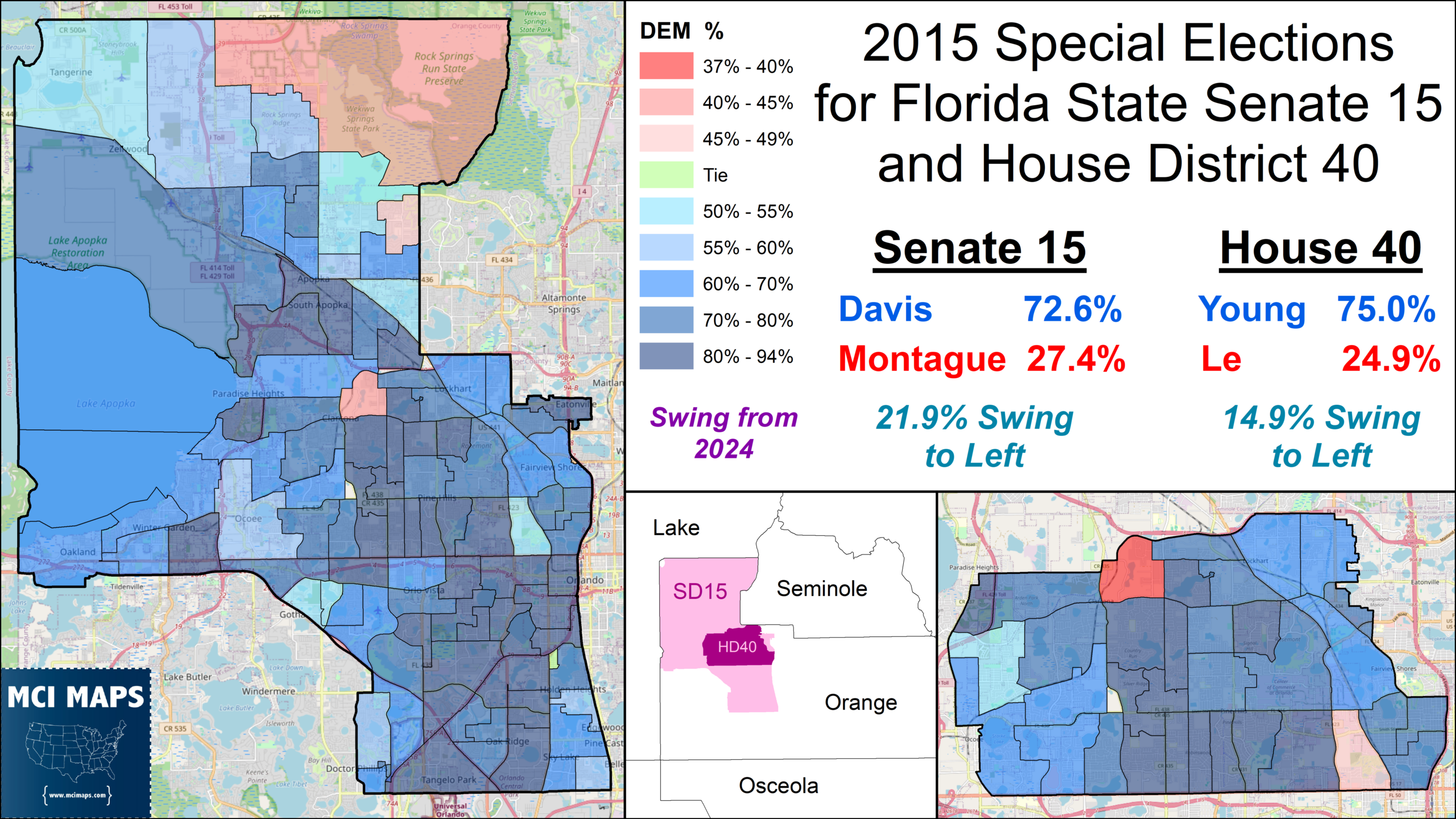
Both of these races saw the smallest Democratic turnout advantages, just around 1%. However, the districts were so blue that the vote cast was still overwhelmingly Democratic. On top of this, both Bracy Davis and Young outperformed party metrics by around 10 points, leading to each district having big swings to the left.
December Specials
On December 9th, the last pair of special elections were held. Both the races were overshadowed by the runoff for Miami Mayor taking place that same day.
Senate District 11
Up in North-Central Florida, the hyper-Republican Senate District 11 seat was opened up after incumbent Blaise Ingoglia was appointed Chief Financial Officer by Governor DeSantis. The district includes all of Citrus, Hernando, Sumter counties, as well as part of Pasco. It is a solid Trump +40 district.
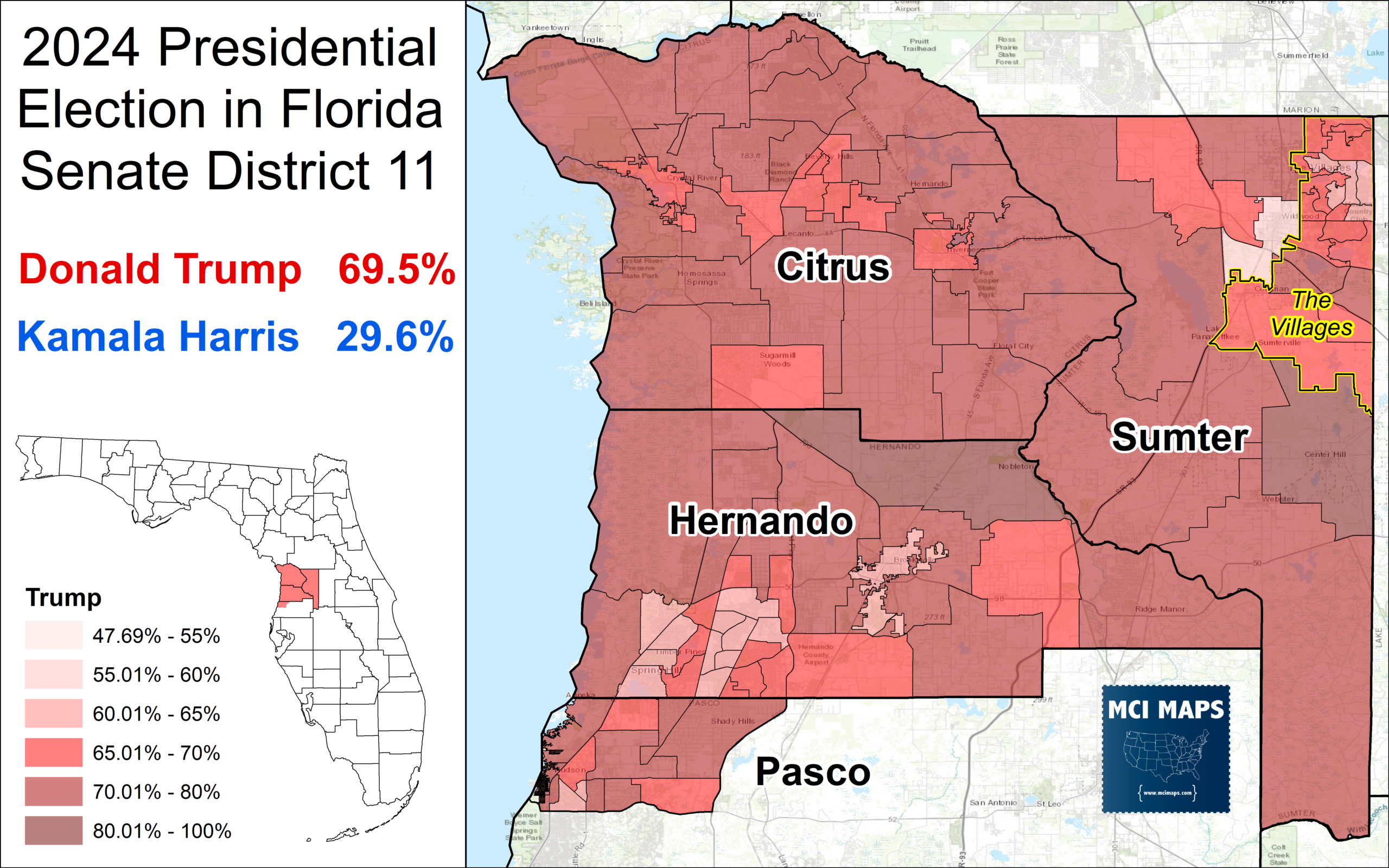
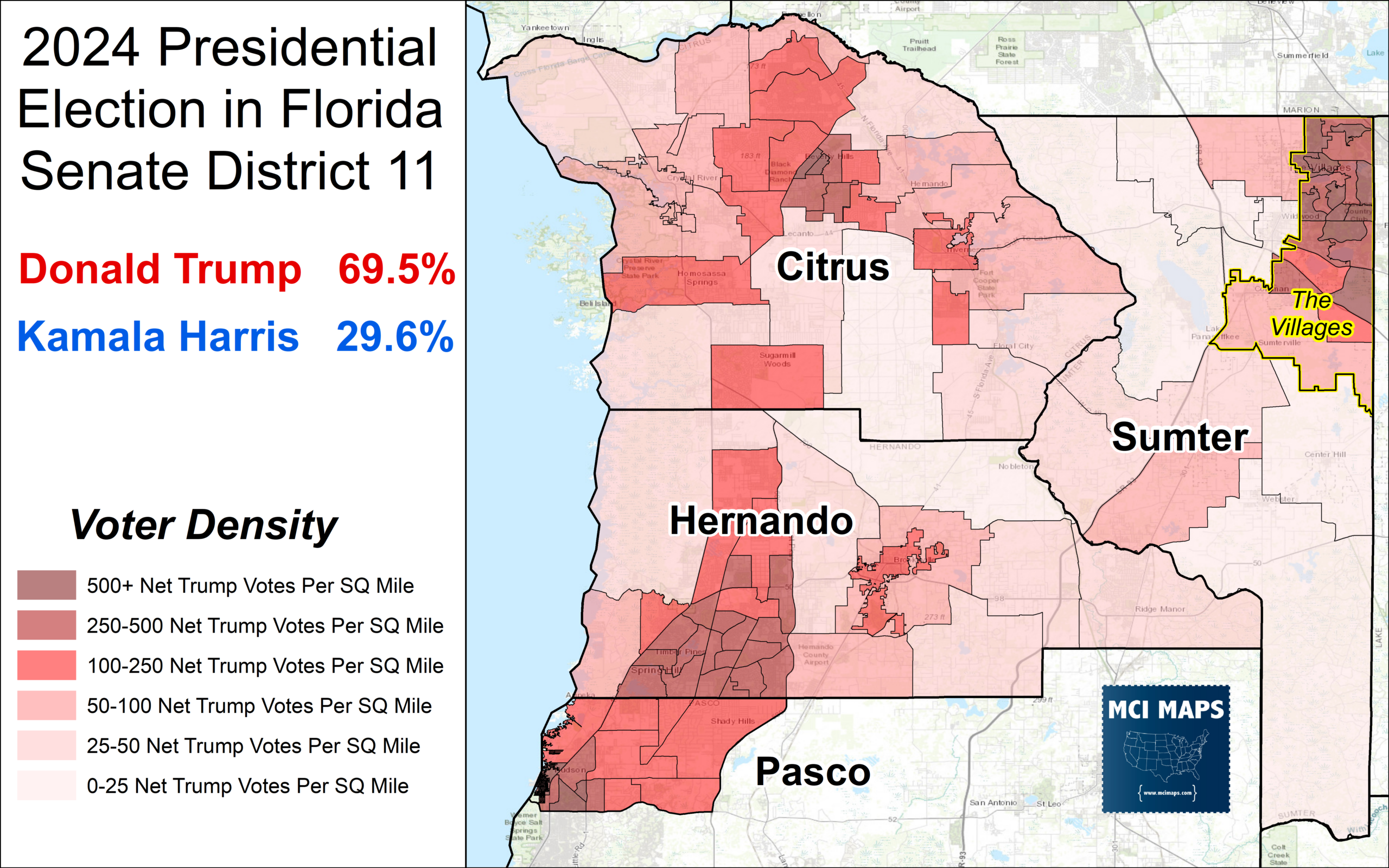
The district is also home to the Villages Retirement community, a well-known Republican retiree destination. The Villages have come to absolutely dominate Sumter county; making up around 80% of its entire vote. Since every precinct backed Trump, here is a map showing the voter density in the 2024 elections.
With such a deep red seat, there is little doubt it will be a Republican hold.
There was no major primary on the Republican side, with State Representative Ralph Massullo easily securing 80% in the primary against activist Anthony Brice. Massullo originally planned to run for this seat back in 2022, and was set up for a primary with Blaise Ingoglia. However, DeSantis, then at the height of his power in the state, endorsed Ingoglia and Massullo opted to run for re-election to the house instead. This go around, DeSantis did not have the power to block Massullo from winning the primary, another reflection of his loss in influence.
The Democratic nominee was Ash Marwah, a civil engineer who lives in the Villages. Marwah was only able to raised $12,000, but he ran as aggressive a race as he could. Marwah had been the Democratic candidate for the Sumter-based HD52 the year before.
The result was a Massullo win. However, the district had a large 21% swing to the left, going just 59-41 for Massullo.
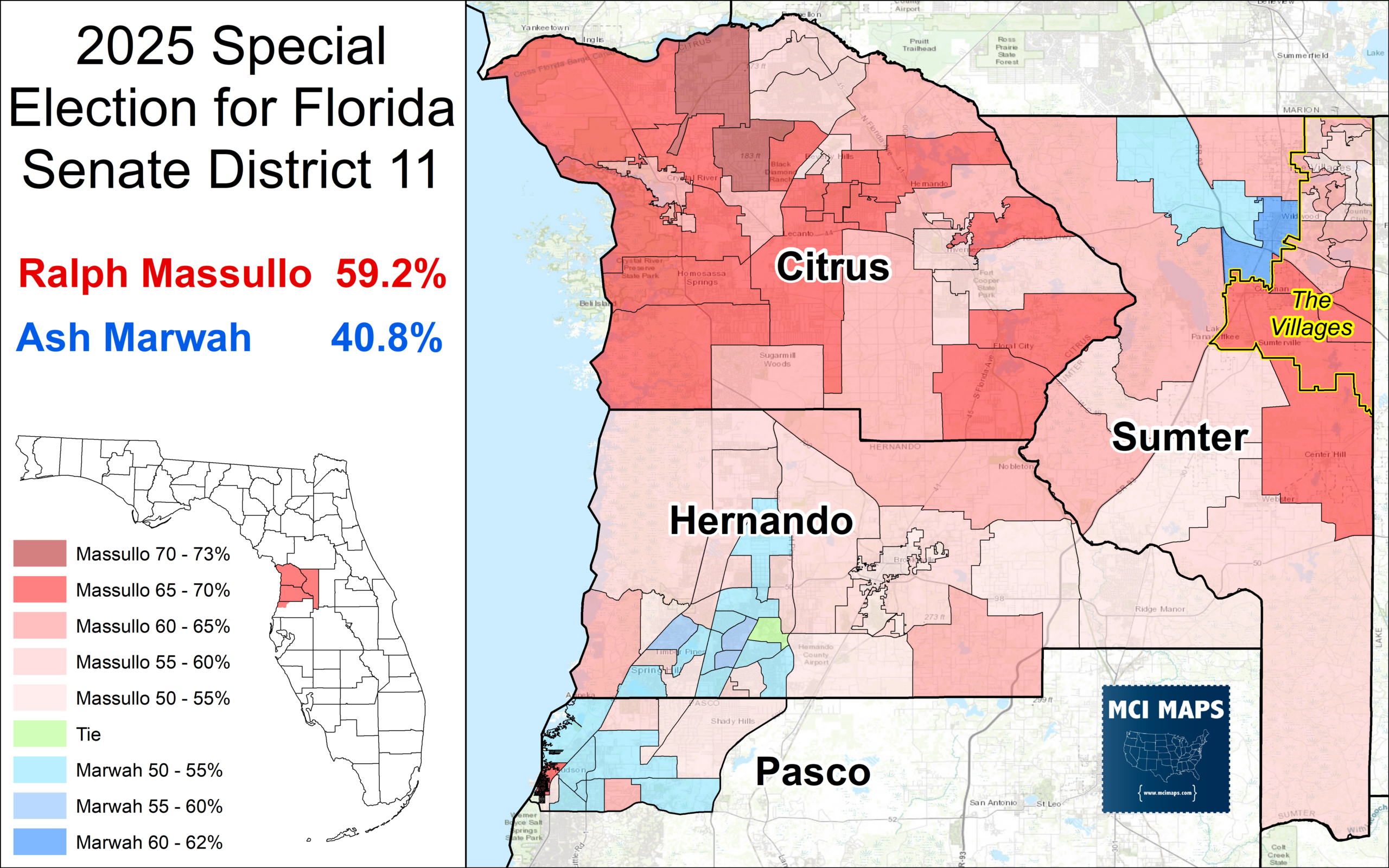
Unlike the Presidential contest, several precincts went blue in this contest. Marwah managed to narrow the margin in the Village; and actually flipped two rural Sumter precincts. He also did well in the towns and villages along Pasco and Hernando; namely the Spring Hill area.
Here turnout was a big factor, with Democrats having turnout 10 points higher than the GOP. This of course left a heavily Republican electorate, with Marwah outperforming the GOP +25 electorate by 7 points. The party metrics breakdown by county is below.
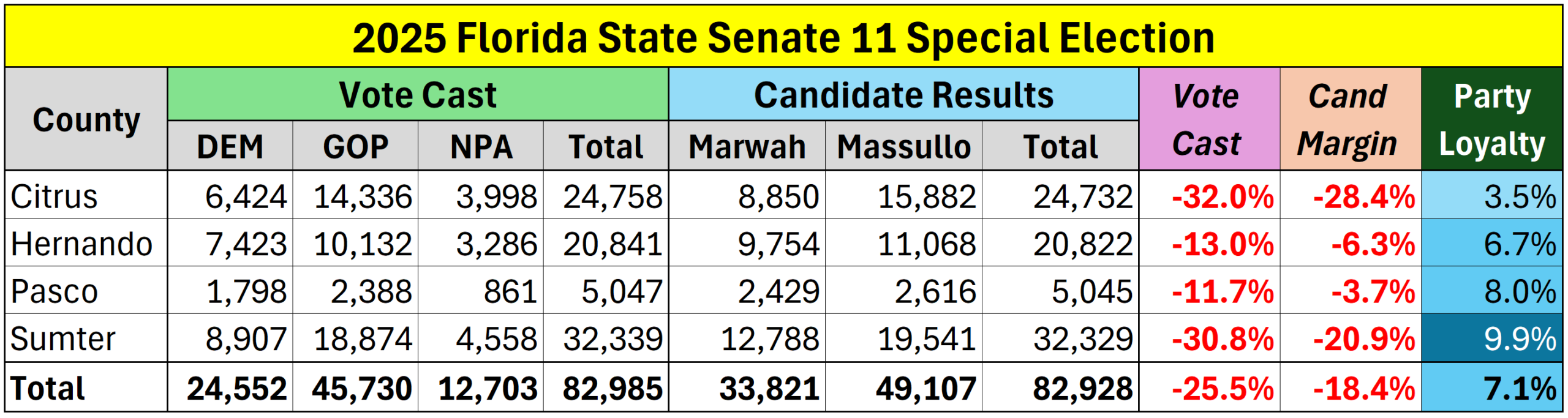
Citrus proved to be the reliable GOP bulwark for the district, with Masullo dominating there and keeping party defections at a minimum. However, over in Sumter County, which as I said is heavily the Villages, Marwah did just under 10 points better than the party metrics.
House District 90
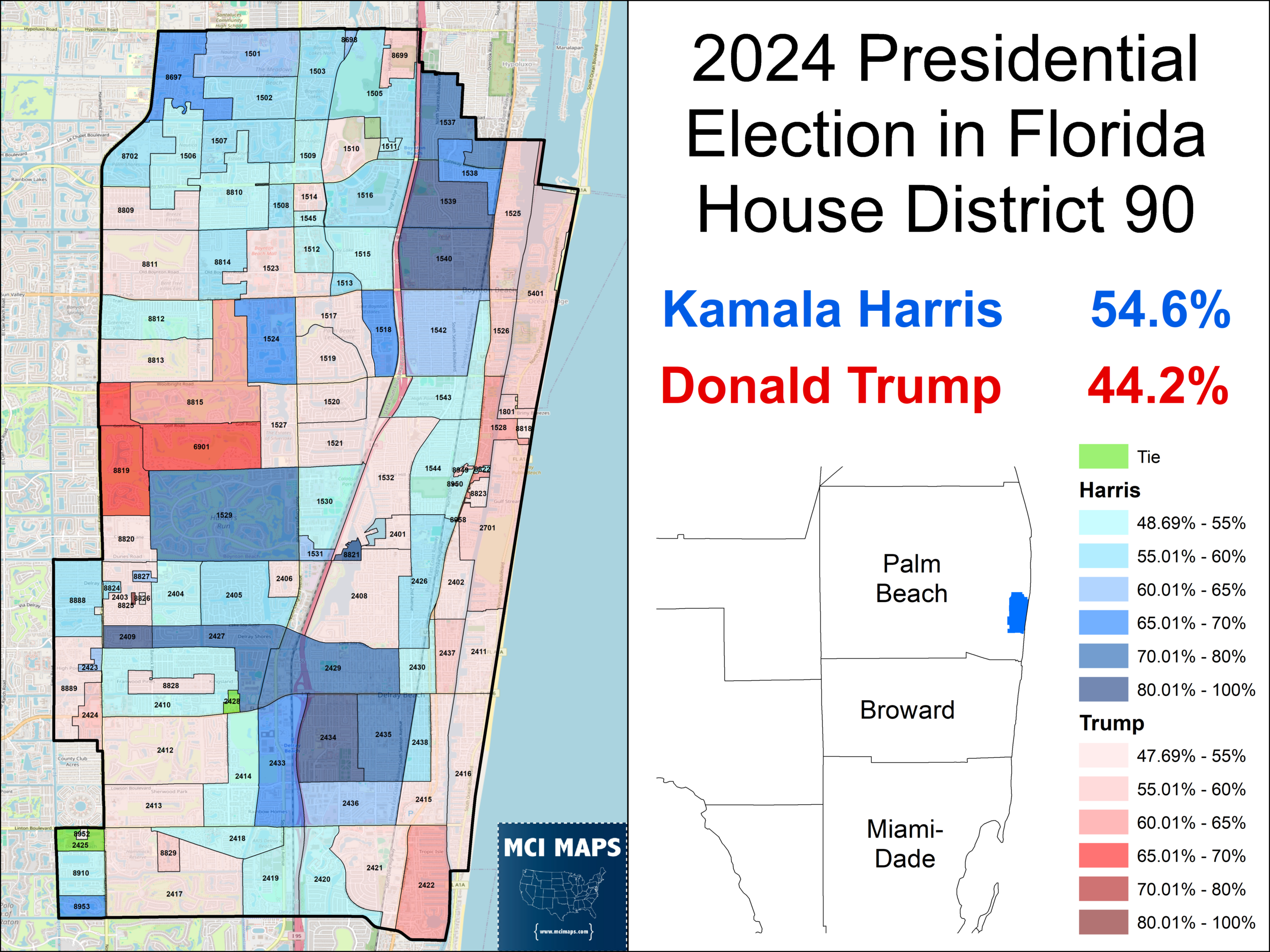
Down in Palm Beach County, a special election was held for House District 90. This seat, covering Delray and Boynton Beach, was vacated due to the untimely death of Representative Joe Casello. The district voted for Harris by 10%, having swung 11 points to the right in 2024.
Democrats quickly rallied around Delray Beach Commissioner Rob Long for the special election. Long was already filed to run for the district in 2026, when Represented Casello was termed out and offering his endorsement. With the sudden special election, Long was able to secure unanimous party support and faced no Democratic challengers.
On the Republican side, two candidates faced off to advance to the general election. This primary was a clash of two different wings of the Republican Party. Maria Zack was a Q-anon conspiracy theorist that subscribed to beliefs ITALY stole the 2020 election for Trump. Bill Reicherter, meanwhile, lampooned Zack for her beliefs and favored more moderate positions, including maintaining vaccine mandates for children. While both would be underdogs against Long, Reicherter was clearly the best candidate to give the GOP a chance. Instead Republicans nominated the conspiracy lady.
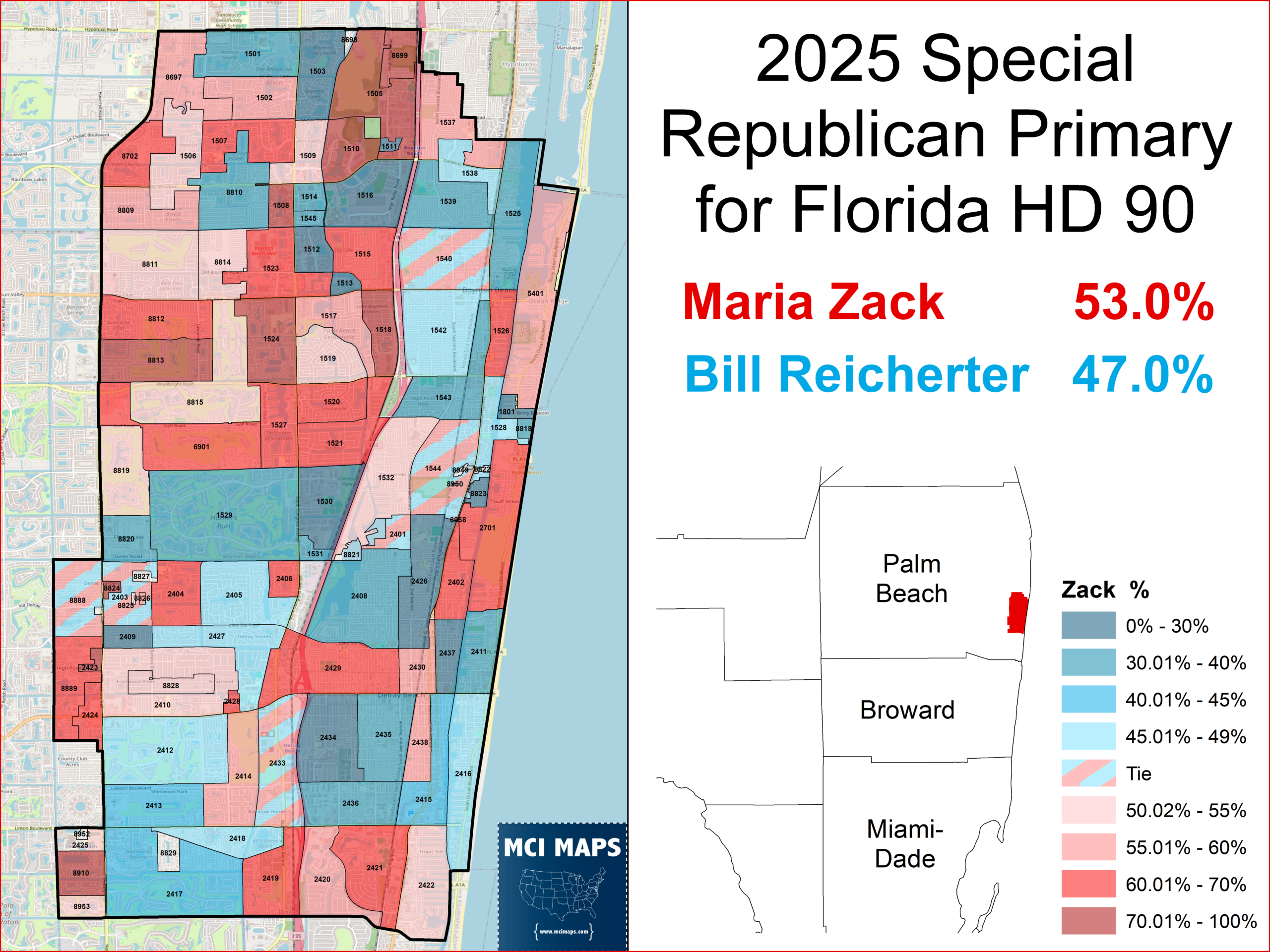
After Zack won the primary, Reicherter, who said Zack was a “single-issue conspiracy theorist” actually openly endorsed Long for the general election. However, with days to go in the election, Reicherter then backtracked and endorsed Zack after all. Perhaps he is holding out hope for a future run and didn’t want to be seen as disloyal.
That general was a quiet affair, as everyone knew Long was destined to win. He far outraised Zack, bringing in at least $150,000 while Zack raised around $60,000 and loaned herself another $30,00. The results came in with Long winning 63% of the vote.
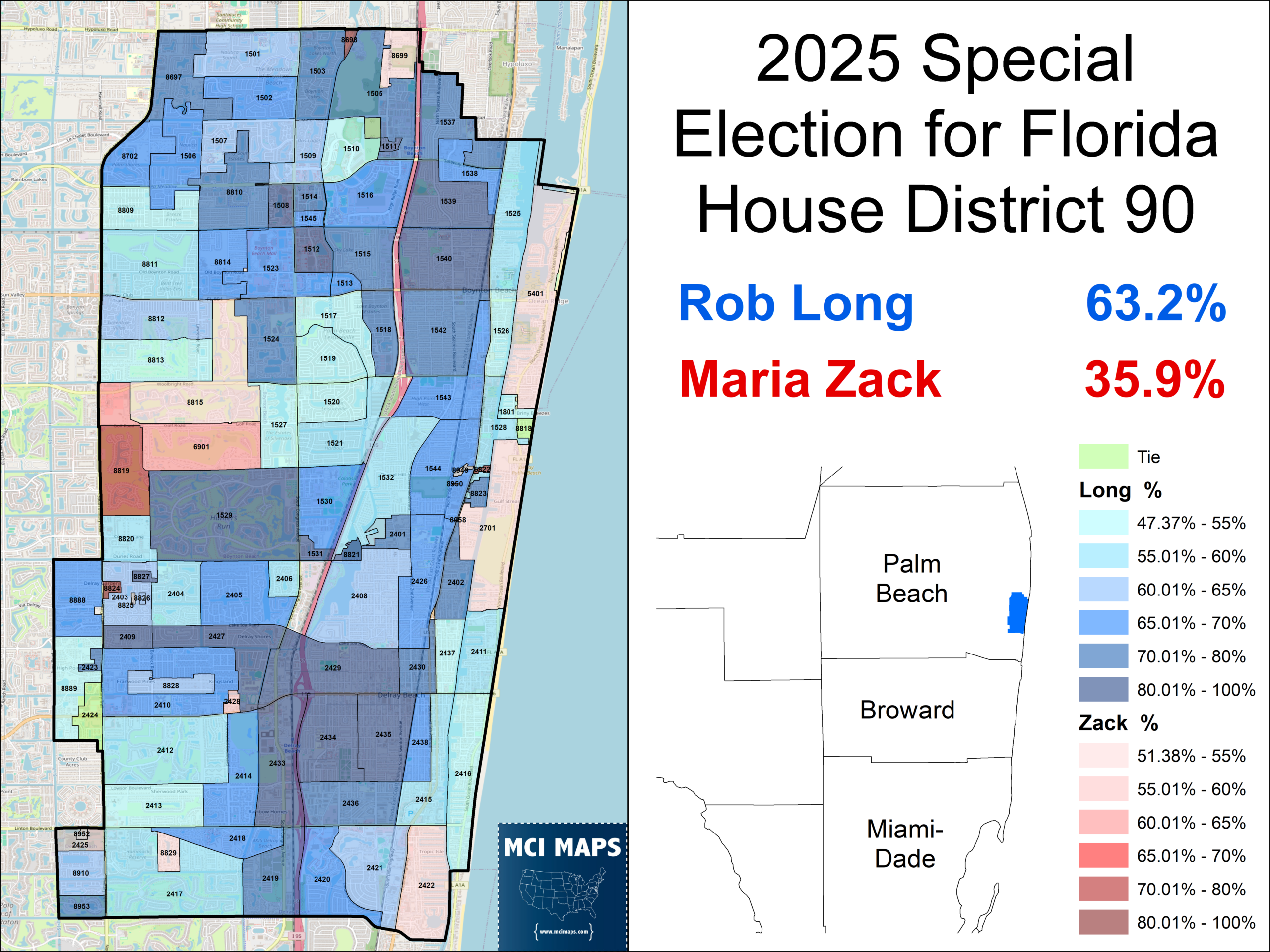
Democrats had a small turnout gap here, right around 3%. Long, however, did 9 points better than the party metrics; with his 27% margin of victory far outpacing the DEM +18% electorate.
With the HD90 and SD11 specials, elections in Florida wrapped for the year!
Final Notes
It of course goes without saying that special election results cannot predict what will happen in a regular turnout general election. However, what we did see across all these contests was a pattern worth considering. Among the voters show showed up, Democrats got higher shares of their voters out. In every race, Democrats outperformed the party metrics; a stark difference from 2024. Yes turnout made these electorates bluer, but then those electorates voted even further to the left than party makeup dictated. As we now head into midterm, the very type of election that seems opposition energized and voters seeking to punish the incumbent administration, these specials do point to Democratic improvement.
How much that potential for Democrats can be realized remains to be seen. One also cannot help but wonder if Florida Republicans are looking at the results and wondering about their plans to gerrymander the congressional map once again. Its trickier to partisan gerrymander (which is exactly why they are considering a remap) when you don’t know how the electorate is going to vote.
Perhaps Republicans should put down the remap software and figure out why their voters are leaving them.